
The constitution of Bangladesh guarantees the fundamental rights of the people of Bangladesh. Article 31, 32, 33 and 35(5) incorporated the provisions of right to protection of law, right to life and liberty, safeguards as to arrest and detention, freedom from torture or cruelty, inhuman or degrading punishment and treatment. Regardless of these constitutional assurances, the citizens of Bangladesh are repeatedly experiencing violence in the custody of law enforcement agencies. A former executive of 'Ain o shalish kendra' marked custodial torture and death as a 'Malicious Culture' in Bangladesh.
Mushtaq Ahmed, a writer, died in prison on february 25, 2021 after being arrested by RAB. He was detained for nine months under the controversial "Digital Security Act" for criticising the government in social media, which has been protested all over the country. On October 11, 34 years old Raihan, a resident of Akhalia in Sylhet, was beaten to death in police custody at Bandar Bazar police outpost. Incidents of torture and custodial death like these are routine affairs in Bangladesh. Report published by 'Ain o Shalish Kendra, 1,426 occurrences of custodial deaths took place from January 2017 to July 2020. Among these 195 occurred in 2016, 162 in 2017, 474 in 2018, 388 in 2019 and 207 from January to July 2020. Alongside police, RAB also has been responsible for over 1000 custodial deaths since its inception in 2004 which has been reported in various research papers.
On 10th December 1984, the UN General Assembly adopted the Convention against torture and other cruel, inhuman or degrading treatment and punishment (CAT) to make the effort more efficacious against torture and other inhuman treatments throughout the world. On 5th October 1998 Bangladesh became a member state of CAT. Besides, Article 3 of the Universal Declaration of Human Rights states that everyone has the right to life, liberty and security of person. Moreover, Article 5 of the same declaration emphasises that no one shall be subjected to torture or to cruel, inhuman or degrading treatment or punishment. Regrettably, the law enforcement agencies of our country do not comply with these provisions.
The power of police to arrest without warrant under section 54 of Code of Criminal Procedure (CrPC) 1898, and placing the accused under section 167 of the CrPC, 1898 in police custody has resulted in violation of fundamental rights in various cases through its abuse. Likewise, magistrate can remand a case for a period not exceeding 15 days under section 167 of CrPC, 1898. This notorious remand process is widely acknowledged as another tool for abusing the police power, as allowing the remand is a matter of no sweat for magistrate in our country.
Undoubtedly, this remand process opens the door to stern human rights violation, torture and custodial deaths. In the case of 'Saifuzzaman vs state (2004)' the High court Division took notice of severe violation of fundamental rights of citizens in the hands of police and failure of the magistrate to act in accordance with law. The court observed that, "to strike the balance between the needs of law enforcement machinery is a perennial problem of statecraft".
Though, the government of Bangladesh on October 2013, enacted 'The torture and custodial death (prevention) Act, 2013' for averting the torture and custodial death in police custody, very few cases have been filed under this act compared to the incidents. Lack of awareness among people about this act and fear of police are the main barriers for not filing cases under this act. Ironically, the act entrusts the police for investigation where questions of neutrality may arise as the investigation is done by a police against another police. Woefully, the act sets out the punishments which are only limited to imprisonment and compensation. Hence, this act needs amendment to make it more stringent.
Meanwhile, the Code of Criminal Procedure, 1898 encourages a culture of impunity and protects the state officials. Section 132 of CrPC, 1898 enumerates that no complaint can be lodged against any state officials without prior approval of government. According to 'Odhikar' (a Bangladesh based human rights organisation) the 'Istanbul Protocol' which is intended to serve as a set of international guidelines for the assessment of persons who allege the torture and ill treatment, is one of the most effective tools for ending physiological dynamics and impunity related to torture through investigation and documentation of the cases of torture and ill-treatment.
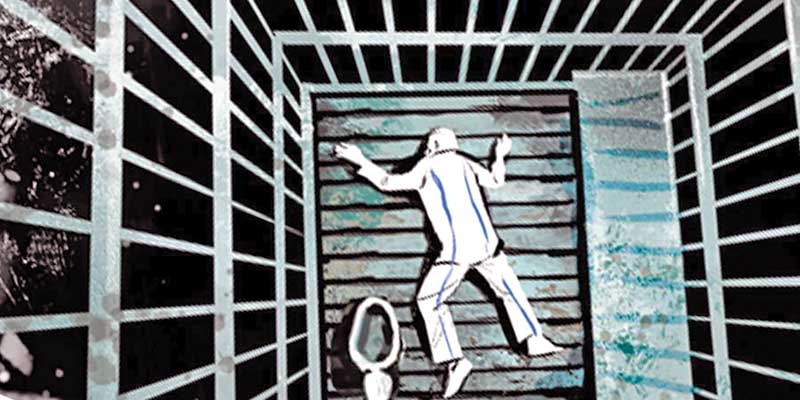
Torture and custodial death are facilitated not only by the provisions of the CrPC but also by the corruption and non responsiveness in the office of law enforcing agencies. Using the system of forced confession and third degree method are major reasons for custodial death and torture. A recent example of this situation can be seen in Jisa Moni case. In this case a girl named Jisa Moni went missing from Narayanganj in july 4, 2020. Following GD, police arrested three persons as suspects. In August 9, the three suspects confessed of raping and murdering the girl in the court. 51 days later of the occurrence the girl reappeared with her husband!
High Court Division in case of 'Blast and others vs Bangladesh' as well as 'Saifuzzaman vs state' provided some guidelines and directions regarding investigation, arbitrary arrest and remand. For preventing custodial torture and death, sections 54, 167 and 344 of the CrPC should be adapted as per the guidelines provided by the Supreme Court in Blast case. The immunity provisions of CrPC, 1898 for public officials that engage in torture must be repealed as well.
A strong legal framework to halt torture is a critical component of any torture prevention strategy. Further, effectual implementation of the legal framework is a must. Before anything else, people ought to be aware of their fundamental rights. Otherwise, their rights will continue to be infringed by the persons who solemnized oath to safeguard those rights.
The writer is a student, Department of Law, University of Chittagong





