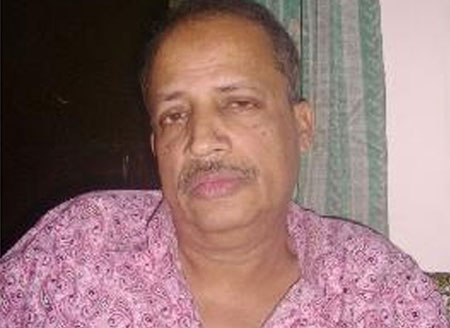
The soul died in A F M Mohitul Islam long years before the heart stopped beating in him on Thursday. The soul was reduced to ashes, to pointlessness, on 15 August 1975. He saw death up close, not of one individual dying, not of two, not of three. It was an entire clan which was gunned down before his very eyes. He watched, helpless and frightened, those majors and colonels and their cohorts in their animal shrieks and screams shooting away in murderous abandon as they ran in and out of the home that was then and is today part of Bangladesh's history. Mohitul Islam watched, his eyes brimming with tears, his life surely about to be put an end to, as the uniformed assassins murdered the Father of the Nation, his loving wife, their sons and daughters-in-law, Bangabandhu's brother and anyone else who happened to be there.
It was the collapse of history which Mohitul Islam experienced in those hellish moments. Sheikh Kamal's corpse lay before him. Above, the sounds of gunfire told him that one by one everyone in the long-suffering family of Bangabandhu Sheikh Mujibur Rahman was being silenced in blood and gore. A frightened, ten-year-old Russell, the baby child of Sheikh Mujibur Rahman and Fazilatunnessa Mujib, held on to him, tightly holding his hand, for dear life. Mohit pleaded with the killers to spare the child. The child, weeping profusely, wanted to go to his mother, not knowing that his mother, like his father and his brothers, was dead, that blood was all over the floor and stairways. He was taken upstairs by a killer. He stepped across the lifeless body of his father, the greatest man in Bangladesh's history, was led up to the first floor, saw his dead mother sprawled half in and half outside her room. The killer then put the gun to young Russell's head and blew his brains out.
Downstairs, detained near the gate, there where the office of what is today Bangabandhu Museum is located, Mohitul Islam heard the shot. He wept even more. He knew the little boy who had only a minute earlier been holding his hand in the desperate urge to live, had rudely been deprived of life. It was then that the soul cracked in Mohit. The heart did not feel anything. The world, in that terribly sinister dawn, had turned into an endless night of evil. The killers did not shoot Mohit. Perhaps because he was not a member of Bangabandhu's family? Perhaps they were by then tired of all the lives they had put out? But Mohitul Islam, with or without a bullet, was dead in that darkness that tailed the crimson dawn. He died with all those other people, everyone of whom he had known so well, everyone with whom he had been part of the Founding Father's family, whom the assassins would not permit to live.
Today, our heads are bowed low, very low, before Mohitul Islam. On that terror-drenched dawn, he was witness to the heart-breaking truth that not a single Bengali, not one of the millions who had been inspired and led by Bangabandhu for years and decades, came forth to save the Liberator and his family from the wild beasts that had descended on his home. Mohit surely kept hoping that help would arrive, that Bangabandhu and his family would live as they had lived through so many crises before. No help came. No help would come. Moments before he was felled on the stairs by the killers, Bangabandhu had come down from his room upstairs to instruct Mohit to get in touch with the police, the army, indeed everyone and anyone who could come forth to ward off the animals taking over the presidential home. Mohit tried several numbers. At one point, Bangabandhu took the receiver from him and, finding someone at the other end of the line, told him, 'This is President Sheikh Mujibur Rahman speaking. . .' Before he could go on, the connection got snapped. Or could it be that whoever had received the call simply put the phone down? Could the truth not have been something else, that everyone in the services --- police, army, intelligence --- was a confederate to the conspiracy to the murder of the Father of the Nation and his family? Bangabandhu put the phone down and went back up the stairs even as the bullets flew around the famous home on 32 Dhanmondi. Minutes later, he was dead. Sheikh Kamal was already dead. And then, one by one, everyone in the family was shot down. Sheikh Hasina and Sheikh Rehana, travelling abroad at the time, would not know until later that they had suddenly been turned into orphans, that the nation had had its guardian angel shot down.
For twenty one years after 1975, Mohitul Islam bore his pain in silence. There was little he could do, for the country had speedily passed into the blood-stained hands of the assassins and their patrons and the beneficiaries of their criminality. At one point, soon after the carnage, he made his way to the nearby police station to record a case over the tragedy. He was treated rudely, even physically assaulted. In the eyes of those policemen he did not matter anymore. He was irrelevant, redundant. If the villains could murder the nation's founding father, they could do anything under the sun to blot out the light.
And the light, for Mohitul Islam and for this nation, would not return until June 1996. He turned plaintiff in the case finally shaped to try and punish the assassins of the Father of the Nation.
Mohitul Islam fulfilled, finally, his responsibility to history. But could his soul return to him? Could the heart in him feel once more the thrill that life was in the happy days when Bangabandhu spent time with his family at home, when the child Russell moved around on his bike around the house, when 32 Dhanmondi came alive, indeed remained alive, with talk of politics and indeed of the world?
Mohitul Islam bore a heavy burden in the forty one years which remained to him of his life. His pain was his own, for he saw unmitigated tragedy unfold before him in August 1975. How much of his pain did the rest of us feel, even vicariously?
August 1975 was a nightmare for him, for all of us. Another August has finally taken Mohit away from us.
Let the angels watch over him as they lead him, by the hand, into paradise. He belongs there --- as those he saw being massacred around him more than four decades ago belong there.
Syed Badrul Ahsan is Associate Editor,
The Daily Observer