



| HEADLINE |

|
Sheikh Mujib: An unparallel leader
Published : Wednesday, 17 March, 2021 at 12:00 AM
Staff Correspondent


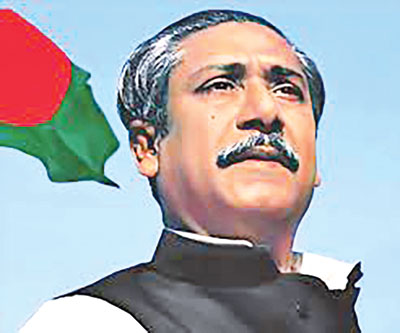 Father of the Nation Bangabandhu Sheikh Mujibur Rahman is such a figure in history that if someone reads Bangabandhu's life thoroughly he/she can easily know the key points of the history of Bangladesh. Starting from the anti-British movement to the anti-Pakistan movement, Bangabandhu has left his mark on every chapter of the history of this country.
None but Bangabandhu Sheikh Mujib could make
himself a leader of all the Bengalis. He was the only person who could identify the much cherished dreams of independence of the Bengalis and he made it real.
His was born and grew up in the alluvial soil of the country. On March 17 in 1920 Sheikh Mujib was born at Tungipara in a respectable Sheikh family. His father Sheikh Lutfur Rahman was a court clerk of Gopalganj civil court and mother Sheikh Sayera Khatun was a housewife.
Bangabandhu was born as the third child in the family of four daughters and two sons. His parents affectionately called him 'Khoka'.
Sheikh Mujib began his schooling at Gimadanga Primary School at the age of seven in 1927. At nine in 1929, he was admitted to Class III at Gopalganj Public School. Subsequently, he was admitted to Gopalganj Missionary School.
Sheikh Mujibur Rahman had an attraction toward sports and a special love for football. He played lots of competitive tournaments where he received awards for his outstanding performances.
Who knew that this Khoka and also a local football player would be the great leader of the freedom struggle of the country?
In 1942, Sheikh Mujibur Rahman passed the Matriculation examination from Gopalganj Missionary School and the same year, got admitted to Islamia College in Kolkata. Mujib married Sheikh Fazilatunnesa (Renu) in the same year at the age of 22 and Renu was 12. Later, they had two daughters, Sheikh Hasina and Sheikh Rehana, and three sons, Sheikh Kamal, Sheikh Jamal and Sheikh Russel.
Before the partition of India in 1947, Sheikh Mujibur Rahman was elected General Secretary of Islamia College Students Union uncontested. On August 16 in 1946, during the communal riots of Kolkata he helped to maintain peace and communal harmony, saving the lives of many members of both the Hindu and Muslim communities.
In 1947, Bangabandhu Sheikh Mujibur Rahman joined Huseyn Shaheed Suhrawardy's move for a United Independent Bengal as a third free state along with India and Pakistan.
After partition, in 1948, Sheikh Mujib got admission to the Department of Law at the University of Dhaka. In the same year on January 4 he founded the East Pakistan Muslim Students' League. It was the first opposition student organization in Pakistan.
He rose in spontaneous protest on February 23, when Chief Minister Khawaja Nazimuddin declared in the Constituent Assembly that the people of East Pakistan must accept Urdu as their state language. Sheikh Mujib immediately plunged himself in overt activities to build a strong movement against the Muslim League's resolve to make Urdu the only state language of Pakistan.
On March 2, a meeting held at Fazlul Huq Muslim Hall approved a resolution placed by Sheikh Mujib to form an All-Party State Language Action Committee. He was arrested along with some political workers on March 11, while they were picketing in front of the secretariat building in observance of the `State Language Bangla Day.' The student community of the country became restive following his arrest. In the face of overpowering student protests, the Muslim League government was forced to release Sheikh Mujib and other student leaders on March 15.
At a reception accorded by the Dhaka University to the Founder and Governor General of Pakistan in March of 1948, Mohammad Ali Jinnah, declared that 'Urdu, and only Urdu' shall be the State language of Pakistan to which the students broke into loud protest led by the young student leader Sheikh Mujib.
In 1949, he supported a movement of the Class IV employees of the Dhaka University then he was arrested on April 19 from the Vice-Chancellor's residence, where he along with some students had assembled for a demonstration.
On June 23, the East Pakistan Awami Muslim League, present Awami League, was founded and he was elected as joint secretary.
In 1952, when the then Prime Minister of Pakistan Khawaja Nazimuddin declared at a public meeting in the Paltan Maidan that Urdu would be the only state language of Pakistan on January 26.
Being in captivity, Sheikh Mujibur Rahman stayed in constant touch with those waging the movement to realize Bangla as one of the state languages. He issued key directives to make the movement a success even from the confines of his prison.
On February 16, Sheikh Mujibur Rahman started a hunger strike that lasted 11 days. He was released from prison on February 27.
In 1953, Sheikh Mujibur Rahman was elected General Secretary of Awami Muslim League at its council meeting.
In 1954, the first elections in East Bengal were held on March 10. The United Front won the elections. The Awami Muslim League alone obtained 143 seats. Sheikh Mujib won the election in Gopalganj constituency and took oath on May 15 as Minister for Co-operative and Agricultural Development in the new provincial government.
In 1955, to be the party of all regardless of religion, the Awami Muslim League was renamed Awami League, dropping the word 'Muslim' from its name. Sheikh Mujib was the party's General Secretary then.
In September of 1956, Sheikh Mujibur Rahman joined the provincial Awami League government headed by Khan Ataur Rahman as a Minister. He remained in the position for 9 months. Mujib voluntarily resigned from the Cabinet on May 30 in 1957 in order to continue as General Secretary of the party and build the party stronger.
In 1957 Sheikh Mujibur Rahman was re-elected the General Secretary of the party at its council meeting held from June 13 to 14. He visited China on an official tour the same year.
On October 7 in 1958, Maj Gen Iskander Mirza took power as president of the country, imposing martial law and banning all political activities. Three weeks later, he was toppled by Army Chief General Ayub Khan and ousted from the country.
On October 11, Sheikh Mujibur Rahman was arrested. Thereafter, he was continuously implicated in false cases. He was released from prison after fourteen months, but was re-arrested immediately at the jail gate.
Sheikh Mujibur Rahman was released from jail following the verdict of the High Court in 1961. He set up an underground network called `Swadhin Bangla Biplobi Parishad', Revolutionary Council for Independent Bangladesh, with leading student leaders in order to work for the independence of Bangladesh.
Sheikh Mujibur was again arrested by the Ayub government on February 6 in 1962. He was freed on June 18, following the lifting of the four-year-long decree of martial law on June 2. He travelled to Lahore on September 24 and formed the National Democratic Front (NDF) with Huseyn Shaheed Suhrawardy and other opposition parties.
On February 5 in 1966, Sheikh Mujibur Rahman presented his historic six-point demand known as the `Charter of freedom of the Bengali nation.' It drew the roadmap for the independence of Bangladesh.
In the council meeting of party held from March 18 to 20, Sheikh Mujibur Rahman was elected President of Awami League. He travelled far and wide in order to gain support for his 6-Point programme and was arrested 8 times during the campaign. After the final arrest by the regime on May 8 in 1966, he was imprisoned for nearly three years.
In 1969, the Agartala Conspiracy Case resulted in a nationwide student movement and mass uprising demanding the withdrawal of the case and the release of Sheikh Mujibur Rahman. Under pressure from the public, the Ayub Khan government was forced to withdraw the Agartala Conspiracy Case and release Sheikh Mujibur Rahman and others on February 22.
Sheikh Mujibur Rahman was given the title 'Bangabandhu' at a mammoth public meeting organized by the Central Student Action Committee at the Race Course Maidan, now Suhrawardy Udyan, on February 23.
At a meeting held on December 5 to observe the death anniversary of Huseyn Shaheed Suhrawardy, Bangabandhu Sheikh Mujibur Rahman declared that East Pakistan would be called Bangladesh from then on.
In 1970, Awami League got a land slide majority in the country's first general elections held on December 7. Bangabandhu chose 'Boat' symbol to represent Awami League. On the basis of his 6-point demand people responded spontaneously.
Awami League achieved 167, including 7 women reserved seats, out of the 169 seats of the National Assembly in East Pakistan and 298 seats, including 10 women reserved seats, of the 310 seats of the Provincial Assembly of East Pakistan.
In 1971, Bengalis from all walks of life took to the streets in massive demonstrations after hearing Gen Yahya Khan's postponement of the National Assembly session on March 1.
On March 7, in his historic speech before millions of people at the Racecourse Maidan, Bangabandhu Sheikh Mujibur Rahman called countrymen to take all out of preparations for the War of Liberation.
Pakistan President Gen Yahya Khan visited Dhaka and held a series of meetings with Sheikh Mujibur Rahman from March 16 to 24, but no resolution could be reached.
At midnight on March 25, the Pakistan army launched its heinous operation of genocide against unarmed Bengalis.
Sheikh Mujibur Rahman announced the Independence of Bangladesh in the early hours of March 26. Right after the declaration, he was arrested and taken to a Pakistani prison.
On April 10, the first government of the People's Republic of Bangladesh was formed and Bangabandhu was elected President by the constituent assembly. Syed Nazrul Islam was elected Vice President and acting President in the absence of Bangabandhu Sheikh Mujibur Rahman, while Tajuddin Ahmed was elected Prime Minister. The leaders took their oaths of office on April 17 at a famous Amrakanan, mango garden, of Baidyanathtala in Meherpur, now known as Mujibnagar.
After nine months of bloody war, Bangladesh got liberation with the surrender of the Pakistani occupation army on December 16, 1971.
In 1972, the government of Pakistan was forced to release Bangabandhu Sheikh Mujibur Rahman on January 8 following immense international pressure.
On that day, Bangabandhu travelled to London on his way to Dhaka. On January 9, he met the then British Prime Minister Edward Heath.
Bangabandhu Sheikh Mujibur Rahman stopped over at Delhi, where Indian President VV Giri and Prime Minister Indira Gandhi welcomed him, before returning to Dhaka.
On January 10, millions of people welcomed the Father of the Nation when he arrived in his motherland. He went straight from the airport to the Race Course Maidan now renamed Suhrawardy Udyan, where he addressed the people of independent Bangladesh for the first time.
Loading...
Loading...
Also read



Editor : Iqbal Sobhan Chowdhury
Published by the Editor on behalf of the Observer Ltd. from Globe Printers, 24/A, New Eskaton Road, Ramna, Dhaka.
Editorial, News and Commercial Offices : Aziz Bhaban (2nd floor), 93, Motijheel C/A, Dhaka-1000.
Phone: PABX- 41053001-06; Advertisement: 41053012; 01793317829, 01550707291, E-mail: [email protected], [email protected] Online: email: [email protected] 41053014; 01550707297 Advertisement: 01550707296
Published by the Editor on behalf of the Observer Ltd. from Globe Printers, 24/A, New Eskaton Road, Ramna, Dhaka.
Editorial, News and Commercial Offices : Aziz Bhaban (2nd floor), 93, Motijheel C/A, Dhaka-1000.
Phone: PABX- 41053001-06; Advertisement: 41053012; 01793317829, 01550707291, E-mail: [email protected], [email protected] Online: email: [email protected] 41053014; 01550707297 Advertisement: 01550707296


