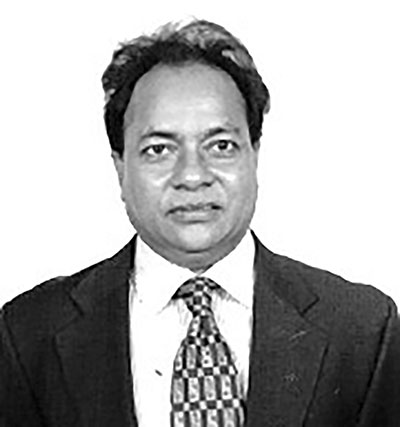
In 1971, I was working in the blood-drenched war fronts as an information officer-cum-war correspondent of Mujibnagar Government. Alongside I discharged my tough responsibilities in the fronts as War Correspondent of Swadhin Bangla Betar Kendra. In front of my eyes, I have seen hundreds of the valiant sons of Mother Bengal falling like wilted flowers in the fronts. Apart from performing my duty as a war correspondent I had to carry many military secrets and my news gathering about the position and defence preparedness of Pakistani troops in the occupied areas of Bangladesh helped the Alliance in formulating their strategy.
Following are some of the tragic stories of those fateful days of 1971.
In the history of the Liberation War, 'Operation Hatibandha' was a memorable chapter. In the entire Sector 6 this was the biggest incident of trial of strength with the Pakistanis. On Mukti Bahini side this war was directed by Captain Motiur Rahman. The Pakistani forces were positioned at Hatibandha Thana headquarters while half a mile away, at Singmari Border Out Post was the defence of the Freedom Fighters. On 27 September they confronted the occupation troops in a face to face encounter.
The Freedom Fighters were positioned on the western side of Goddimari and Naota, on the western side of Teesta. were two companies of FF, at Singmari BOP was one company under Subedar Fazlur Rahman, farther west were Subedar-Major Borhanuddin and his force, farther west were Major Mesbahuddin and his regulars and FF combined force, beside them Subedar-Major Abdul Malek and his force, and still farther west was Subedar-Major Ghulam Mustafa with his force. On the other side of the Teesta there was another company of the FF under Major Nazmul Huq for protection.
The Pakistani occupation troops were positioned at Hatibandha College, CO (Dev) Office, and in bunkers along the bank of the Teesta. Besides two companies of Pakistani regular forces they had two companies of EP Cap (a force on the lines of the EPR), and another large force of one thousand four hundred Razakars. They were given covering by a full Punjabi artillery and their weapons included artillery, heavy machineguns, 3-inch. mortars, 2-inch. mortars, 2-inch rocket Launchers, LMGs, etc.
Behind the Freedom Fighters was an artillery column of the Allied Forces. Mukti Bahini was equipped with 3-inch mortars, LMGs, SLRs, and included about three hundred men under the command of Captain Motiur Rahman (BB).
At dawn on 27 September began the exchange of fire. The battle lasted throughout the day. By the afternoon firing on both sides subsided. Before dark a few Freedom Fighters quietly drew the group of Subedar-Major Fazlur Rahman a few hundred yards towards the defence line of the Pakistanis. Soon after taking position they started firing. The occupation troops were thrown into disarray. Captain Motiur Rahman ordered the entire force to advance. It became impossible for the Pakistanis to resist the advancing Mukti Bahini. Every minute the Freedom Fighters were leaving their bunkers and advancing in bold strides. The trend of the battle was tilted in favour of the Freedom Fighters by 7 in the evening.
Pakistan artillery force engaged in the battle directly and began to fire shells and rockets on the advancing Mukti Bahini. With great difficulty Captain Motiur Rahman saved his force from being routed. Motiur Rahman crawled from one bunker to another so that the morale of no Freedom Fighter is weakened. He patted the Freedom Fighters on their backs, placed his hand upon their chest and infused confidence into them and roused their spirits. The battle of 27 September at Hatibandha was a do-or-die one. They fought on bravely in a situation where it was difficult to withstand the enormous superiority of weapons of the enemy. These gallant fighters are to be counted in the universal history of gallantry.
In the midst of deadly firing when death was precariously close, everyone was fighting bravely, no one was retreating a bit. The commander himself was crawling. At times he had to duck to escape enemy fire, yet he was advancing towards Subedar-Major Fazlur Rahman. By that time Fazlur Rahman's voice on the wireless was growing fainter. Those who were in the bunkers 600 yards behind were weeping. The valiant fighter Fazlur Rahman's voice was getting choked. On the wireless he was told that Motiur Rahman himself was running towards his bunker and would reach him within minutes. But before the captain could reach that bunker Fazlur Rahman's life was fast ebbing.
On wireless in his faint voice he wanted Kalima taiyaba to be read to him. Six hundred yards away in front of the wireless everyone burst into sobs. By the wireless Kalima taiyaba was read to him a few times--La ilaha illallah Mohammadur rasulallah.
On the wireless his faint and gasping voice was heard: "We became martyrs in the path of Allah. Let Allah send His angel to save Bangabandhu's life. He will make us free." For the last time his voice was faintly heard on the wireless: "La Ilaha illallah". He was called many times on the wireless but no reply was forthcoming. This national hero embraced martyrdom like a true hero after shedding his blood in Hatibandha. At Hatibandha on that night six others fell martyrs and more than 30 were wounded.
Two days later the Freedom Fighters captured Hatibandha. More than nine hundred Razakars surrendered. The Razakars disclosed that the Punjabi soldiers carried back their dead bodies covered in two trucks. Today, in humility one would ask how many know the names of these heroes?
The 16th December is the landmark date in our nation's life. It is the date on which we saw light after darkness, a new sun-etched flag was raised signalling the birth of the Bengalee nation. We must renew our pledge to build Sonar Bangla as dreamt by our Father of the nation Bangabandhu Sheikh Mujibur Rahman.
The writer is former secretary to the Govt of Bangladesh and war correspondent of Swadhin Bangla Betar Kendra





