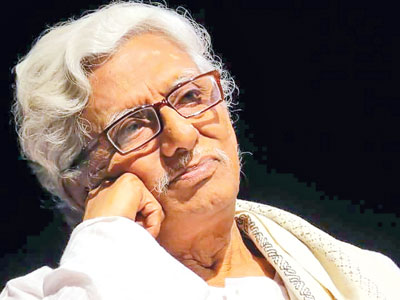
Ekushey Padak winning renowned journalist and cultural personality Kamal Lohani died of novel coronavirus on Saturday. He was 86.
He breathed his last while undergoing treatment at the intensive care unit (ICU) at Sheikh Russel Gastroliver Institute and Hospital around 10:15am, his son Sagar Lohani confirmed it through a Facebook post.
Kamal Lohani, who tested positive for coronavirus on June 19, was on life-support at the hospital since Friday evening. Besides, he was suffering from kidney and lung infection along with other health problems.
Family sources said Kamal Lohani was laid to rest at his family graveyard in Ullapara upazila of Sirajganj.
On June 17, the Language Movement veteran was admitted to Health and Hope Hospital at Panthapath in the capital. He was shifted to Sheikh Russel Gastro Liver Institute and Hospital on June 19.
Just after his death, people from all walks of life started paying homage to the eminent cultural personality on social media.
President Md Abdul Hamid and Prime Minister Sheikh Hasina expressed deep shock and sorrow at the death of Ekushey Padak winning renowned journalist, cultural personality and freedom fighter Kamal Lohani.
In a condolence message, the president said, "Apart from journalism, Kamal Lohani made great contributions to our great Language Movement and the Liberation War." The country has lost a great journalist and cultural figure and his death is an irreparable loss to the cultural arena of the country, he added.
In her message, the Prime Minister said: "We have lost a progressive personality and an extraordinary warrior of non-communal spirit."
Road Transport and Bridges Minister Obaidul Qauder, Health Minister Zahid Maleque, State Minister for Cultural Affairs KM Khalid, Jatiya Party Chairman Golam Mohammad Kader expressed deep shock at Kamal Lohani's death.
Besides, Jatiya Press Club also expressed deep shock at Lohani's death.
Born in Sirajganj's Ullapara in 1934, Kamal Lohani completed his secondary education at Pabna District School in 1952. He later went to Pabna Edward College where his formal education would end upon graduation.
During his final year at Pabna District School, Kamal Lohani took part in the Language Movement of 1952 which marked the beginning of his involvement in politics.
In 1953, he was sent to jail for his part in the attempts to block the arrival of Muslim League leaders, including Nurul Amin, in Pabna. Shortly after his release, Lohani was arrested again in 1954 and it was at that time that he was drawn to the ideology of communism.
He was arrested again a year later and this time he ended up sharing a jail cell with Bangabandhu Sheikh Mujibur Rahman and Tajuddin Ahmad.
Lohani contributed greatly to the Liberation War. He was jailed and tortured several times for his political activism during the Language Movement and the Liberation War. Kamal Lohani performed as the head of news of Swadhin Bangla Betar Kendra during the Liberation War of Bangladesh in 1971. In 1962, he joined Chhayanaut, a cultural organisation, as its secretary.
In 1981, he resigned as the editor of the Daily Barta and started organising cultural movement with renewed vigour. He also played an integral role in the formation of a joint cultural alliance.
Kamal Lohani began his career in journalism with the Daily Millat in 1955. Since then, he worked in important positions in Azad, Sangbad, Purbodesh and Dainik Barta.
A serious activist and writer, Lohani produced many books, including Edesh Amar Gorbo, Bhasha Sankskriti O Ganomadhyam, Amader Sankskriti O Sangram, and Rajniti Muktijuddho Swadhin Bangla Betar.
He served as the director general of Shilpakala Academy from April 2009 to April 2011.
Awarded with the prestigious Ekushey Padak in 2015, Kamal Lohani was a former president of Dhaka Union of Journalists.





