



| HEADLINE |

|
Mujib Borsho: A glorious year in our history
Published : Wednesday, 18 March, 2020 at 12:00 AM
M Matiur Rahman


M Matiur Rahman
Our government deserves special thanks and is admired all over the country for its sincere effort to celebrate Mujib Borsho to show honour and respect our great charismatic leader, Bangabandhu Sheikh Mujibur Rahman who is held in high esteem like other world leaders such as Mahatma Gandhi, George Washington, Abraham Lincoln, Nelson Mendala and others.
A fascinating glimpse of his great political career shows how he rose to prominence joining Muslim Student League in 1939; becoming General Secretary of Kolkata Islamia College in 1945, becoming counsellor of Muslim league; joining All India Muslim Students Federation; forming East Pakistan Awami Muslim League; its joint Secretary; then General Secretary; winning United Front's general election; proposing his historic six points in the general conference of the opposition parties in Lahore; his absolute victory in the 1970's election; his epoch-making speech on 7 March 1971, declaration of independence on 26 March 1971; his arrest after this and release on 8 January 1972 and taking oath as the PM of Bangladesh on 12 January 1972.
He vehemently protested against President Ayub's martial law and mounted pressure upon the government by his six point movement. His landslide victory in the parliamentary election and his 7th March historic speech against the backdrop of the Pak military junta's undemocratic and unlawful action not allow him to form government as the PM of Pakistan being a majority party leader. This compelled him to declare the independence of Bangladesh. Though he was imprisoned in Pakistan, yet his inflammatory speech instilled courage into our freedom fighters to defeat the vast Pakistani army on 16 December 1971 within nine months of war of Liberation.
Significance of the celebration of Mujib Borso
Now I would like to focus on why the celebration of Mujib Borsho is significant in our national history. A close analysis and discussion of his character, achievement, ideals, morals and values will not only help the international community but will also help our youths and forthcoming generation to understand him.
His heroism, courage and relentless struggle are worth learning for our young boys and girls. He is not a name but an institution. His assassination in 1975 by some misguided army officers is a dark chapter that stigmatized our nation. But there is a glory that shines upon our tears for him.
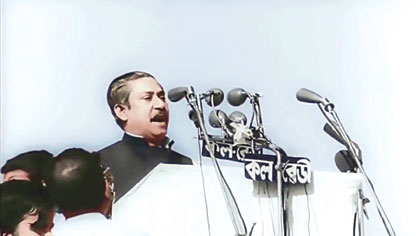
It is universally true that no leader has ever born in the world to deliver such a forceful speech that created a thrill of excitement and sensation in every bosom of those who have heard his thought. His provoking address to the nation at Suhrawardi Uddan: "Ebarar Sangram Muktir Sangram, Ebarar Sangram Shadhinatar Shongram" still gives us an eternal vibes.
This greatest speech of Bangabandhu changed the fate of the nation. It was also honourably recognized by the UNESCO by preserving it in the world heritage among other great speeches of the international leaders. Had he not delivered any speech after this, he would have been the greatest politician and statesman of the world just as Abraham Lincoln, the renowned US President would have been the greatest president, had he not made any other speech after his Gettysburg address.
 The short but rhetorical speech of Lincoln was about equal right and democracy: "That a government is of the people, by the people and for the people, shall not parish from the earth" This address at the Dedication of National Cemetery at Gettysburg, 19 November 1863 still remains the greatest speech in political history. But Bangabandhu's speech stands unparallel because of its enthralling, pervasive and impressive appeal to the minds of all people of all ages. In his speech, there is charisma and magic for the oppressed people of Bangladesh and that of the world. Martin Luther's speech which he delivered against racialism was materialized by Abraham Lincoln after a long time.
He gave a call to non-cooperation movement just like Mahatma Gandhi but this was different in the sense that there was no violence and indiscipline as he said that the Hindus, the Muslims and non Bangalees are his brothers while there was riot during Gandhi's non-cooperation movement. But the fact is that both of them were successful in their mission. Gandhi's non-cooperation moment forced the British to quit India in the like meaner Bangabandu's non-co-operation compelled the Pakistanis to succumb to defeat in the long run. He made adjustment between Gandi's non- cooperation movement and the armed struggle of Netaji Subhas Chandra Bose who said, "Give me blood, I will give you freedom" But Bangabandhu said "Rakta Jokhon diachhi, rakto aro dibo, edesher manuskha mukto korey chharbo, Inshallah." His firm determination came true with the achievement of Bangladesh. He did the politics of sacrifice and he united the people.
The politics of Bangabandhu was tactful. It is evident from his 7th March speech in which he did not straight declare independence in case the Pakistanis should regard him as a separatist and kill thousands of innocent people on that day. But the declaration of independence was implied in his speech which the enemies could not at first realize. Moreover, his historic six points was the charter of the nation which he propagated though his hectic and sudden tour in different parts of the country. To him it was the demand of the people and the constitution of Pakistan must be based on it. He stressed the abolition of martial law and the return of the army to the barracks. He apprised his countrymen of the history of 23 years rule of repression, exploitation and disparity by the Pakistanis. Our PM in her speech on the occasion of 7th March, 2020 highlighted his contribution as follows:
(1) The Father of the Nation gave us freedom. (2) He had contribution in the achievement of Pakistan. (3) He attained success in short time (4) He worked for the people and loved them very much. (5) In answer to her question why Bangabandhu wanted independence she said that he wanted to give education to the illiterate and food to the starving people. He showed the dream of freedom to the frustrated nation (6) He gave direction to the people form House No-32. He gave them guidelines for liberation war and united tem. (7) He had wonderful power of prophecy. (8) He told about political, economic and religious freedom. (8) His 7th March speech would inspire the people for all ages (9) He formed revolutionary council. (10) He took every step with skill.
We know that Bangabandhu was devoted to his duty, he had the habit of enduring hardship and above all, his political acumen helped him reach the highest level of perfection unlike others:
"The heights of great men reached and kept,
Were not attained by sudden flight.
But they while their companions slept,
Were toiling upward in the night."
I had a chance to hear his rousing speech in which he often quoted lines from the poems of Tagore, the greatest poet of our literature. He was rightly called a poet of politics. A song that was sung in a large gathering in praise of him is still ringing in my mind. "Bangabandhu eshechhe prio, Bangalee go azi jago." We were young at that time and our heart were filled with inspiration by his speech of patriotic fervour. As a matter of fact, the speeches that Bangabadhu delivered were infused with the spirit of enthusiasm just like the great speech of the war veteran British PM Winston Churchill:
"We shall fight on the beaches,
We shall fight on the landing grounds,
We shall fight on the fields and
We shall fight in the hills, in the streets,
We shall never surrender."
(Speech in the Hose of Common 4 June 1940)
Though Bangabandhu spent 13th years in jail on being implicated in deferent cases including Agortala Conspiracy and Six Point Demand, yet he did not surrender. He was rather undaunted and indomitable in his determination.
But a great leader like him is rare in the world. Had there been no Bangabandhu, there would been no Bangladesh. Indeed, our youths and new generation will draw much more inspiration from his consciousness and values:
"Lives of great men all remind us,
We can make our lives sublime."
Our government is right in its endeavor to turn Mujib Borsho as the people's Barsho to honour the Father of the Nation and uphold his achievement to transform Bangladesh into Sonar Bangla. He will be remembered by his countrymen and the freedom loving people of the world as one of the greatest leaders for his undying contribution. He was nobler than his deeds: "Tomar Kirtir cheye tumi jee mohot."
The writer is a columnist
Loading...
Loading...
Also read


Editor : Iqbal Sobhan Chowdhury
Published by the Editor on behalf of the Observer Ltd. from Globe Printers, 24/A, New Eskaton Road, Ramna, Dhaka.
Editorial, News and Commercial Offices : Aziz Bhaban (2nd floor), 93, Motijheel C/A, Dhaka-1000.
Phone: PABX- 41053001-06; Advertisement: 41053012; 01793317829, 01550707291, E-mail: [email protected], [email protected] Online: email: [email protected] 41053014; 01550707297 Advertisement: 01550707296
Published by the Editor on behalf of the Observer Ltd. from Globe Printers, 24/A, New Eskaton Road, Ramna, Dhaka.
Editorial, News and Commercial Offices : Aziz Bhaban (2nd floor), 93, Motijheel C/A, Dhaka-1000.
Phone: PABX- 41053001-06; Advertisement: 41053012; 01793317829, 01550707291, E-mail: [email protected], [email protected] Online: email: [email protected] 41053014; 01550707297 Advertisement: 01550707296


