



| HEADLINE |

|
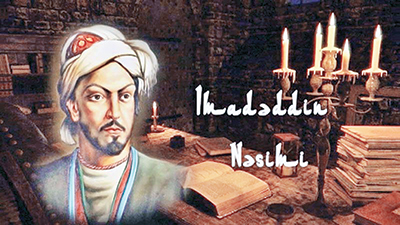
Nasimi - Peak of Azerbaijan literature
Hecer Huseynova
Published : Saturday, 2 November, 2019 at 12:00 AM
(Translated by Ismayilova Mesme Aliyullaqizi)


 It is known, persons which are loved are made of legendary qualities. Nasimi was one of these legends. One of the many searches of academician Z. Bunyadov was in this direction; Nasimi's death fact had investigated. The most spreading thought was executing Nasimi alive and striping off his skin. Bunyadov touched to this thought differently and said that it isn't true. Generally, there are few facts about how the poet was killed.
Information about the name and death of Nasimi is very different. In Arabic sources were written: "Sheikh ImaddinNasimi (Tabrizi), who lived in Halab, was killed in 1417� They cut off his head, removed his skin and crucified the corpse.It seems, that medieval Arab author wrote the penname of Nasimi as Tabrizi, not Shirvani.
Only Muhammad Rahib gave exact information, which connected Nasimi. He wrote that the execution of Nasimi occurred during the time of Yashbak ibn Abdullah al-Yusifi. As if Nasimi was misleading people with his poems. Therefore, his death was verdict .During the trial, Yashbek told Nasimi that, "if you don't prove what you say, we will kill you." Ibn al-Shankasi, a judge - who took part there, opposed the decision. At that time, Nasimi said nothing, only prayed .Sheikhs of HanbaliShihabaddin, demanded the death of poet, from Fakhraddin and he himself wrote the death verdict and presented it to the judges - who were present in court. They didn't agree with this verdict.
 Fakhraddin said that there is the special assignments from Sultan al-Ma'ai on specific instructions regarding the killing or arrest of Nasimi, and that's why poet was taken into custody and arrested.Only after the decree from Sultan al-Maadi, Nasimi was executed, his corpse was shown to people who live in Halab for seven days, then the was torn to pieces.Even part of the corpse was sent to Alibey Zulkarade and his brother Nasraddin. Muhammad Rakib also noted that even there were excerpts from Nasimi's best-selling verses.
Imadaddin Nasimi's name was writtin in the History of Azerbaijani Literature as one of the honorable creativities. Imadaddin Nasimi was one of the creators of philosopher in the poetry , the great mujahedeen of khurifizm .The poet's worldview - the philosophy of life found its full expression in lyrical and philosophical poetry.Taking of Sufism, and then Khurifism on his young hood was explained found in all of his poetry.
In general, the poet was mainly the author of the verses. In literature, poems written in the genre of love tell about love (partly also in political verses). According other poets, Nasimi's love is divine.In these cases, the person can connect with the Almighty through the moral cleansing and became perfected.
Coming through the love to the target
With the love are coming to the Almighty
With the love are joining to the Almighty
With the love are getting to the Almighty
The lyrical hero which Nasimi described - is a symbol of a human in love, and the lover is a symbol of the Almighty.Like many classical poets, Nasimi's love is divine love - love of God.The love described by the poet - is philosophical.These verses reflect the views khurifizm of the poet.Nasimi's divine love expresses love not only to himself, but also the love to the Almighty .The inner purity of God's creation reflects perfection and, at least, approaching to God.The images of Nasimi in gazelles filled with love, of course, are symbolic: a loving person, a God in love.ImadeddinNasimi considered his teacher Naimi to be a pure, perfect man and appreciated his every word as the word of Almighty , and even said this in his verses :
Gave my heart to strange shakh
Gave my heart to the luminous face
As ? gave my heart to Fezlullakh
Gave my heart to evident Almighty.
However, it should be noted that these ideas don't apply to all poems of the poet.ImadeddinNasimi has also verses which delight worldly, real and beauty love.
Example:
My heart ill , only for a beloved
Who has black eyersand eyerbrows .
her whiming , we oblige getting this ,
must sacrifice , for this sweethearting
Nasimi, who succeeded fame in his poems in all themes, is more magnificent even with socio-philosophical verses.
All secrets of the universe are explained by man. In this poem, the poet explains the person as the creator , had been created , as jewels, as time and place. These ideas are expressed in the poem as follows:
The whole world is me, world is me, me!
The world of truth is me, is me, me!
The falling world is me, falling me, me !
All these saying is me, these me, me!
In this part we see that Nasimi could see all the secrets of the universe in letters and proves it.As written in the above, the universe consists of ka (?) and reality (?), consists of letters.The secret of all privacy in letters, in holy books and in the Quran.If we look at this philosophy from our modern day, we will again see that the secrets of the world, the despair of helplessness are presented in books and letters. Only a perfect person should read and understand them.
Another magnificent poem by ImaddaddinNasimi is t" Sigmasam" ( ? don't fit in ) This poem can be considered the peak of Nasimi's creativity .
Both worlds will fit in me, but I can't fit into this world ...
I am without a country, and I will not fit in being
This - the second line - the line which was agreed. But other line is -" Both the world fit in me "Some scientists analyses this combination as may "be ".But we don't agree with this , because in this case there is no thoughtful thing. This is impossible, that poetry of Nasimi was presented by tis way. In the case of the "two" worlds, there are material and spiritual (physical and spiritual), temporary and eternal life, light and darkness, good and evil, disease and health, In short, "dualism." Therefore, it is reasonable to consider this option satisfied.
During the Nasimi's mission, all judges and enemies of Islam were worried; the philosopher poet wasn't persecuted for his religious, but political views and had sentenced to death.
One of the peaks of Azerbaijani poetry, Nasimi was not a simple person, but a person with a deep and extraordinary mind, a genius.
The writer is a professor, Azerbaijan State Pedagogical University
Loading...
Loading...








Editor : Iqbal Sobhan Chowdhury
Published by the Editor on behalf of the Observer Ltd. from Globe Printers, 24/A, New Eskaton Road, Ramna, Dhaka.
Editorial, News and Commercial Offices : Aziz Bhaban (2nd floor), 93, Motijheel C/A, Dhaka-1000.
Phone: PABX- 41053001-06; Advertisement: 41053012; 01793317829, 01550707291, E-mail: [email protected], [email protected] Online: email: [email protected] 41053014; 01550707297 Advertisement: 01550707296
Published by the Editor on behalf of the Observer Ltd. from Globe Printers, 24/A, New Eskaton Road, Ramna, Dhaka.
Editorial, News and Commercial Offices : Aziz Bhaban (2nd floor), 93, Motijheel C/A, Dhaka-1000.
Phone: PABX- 41053001-06; Advertisement: 41053012; 01793317829, 01550707291, E-mail: [email protected], [email protected] Online: email: [email protected] 41053014; 01550707297 Advertisement: 01550707296


