



| HEADLINE |

|
The Unabashed Romantic
Parveen Shakir: The Brave, Dazzling and the Beautiful
Published : Tuesday, 27 August, 2019 at 12:00 AM
Iftakhair Hossen


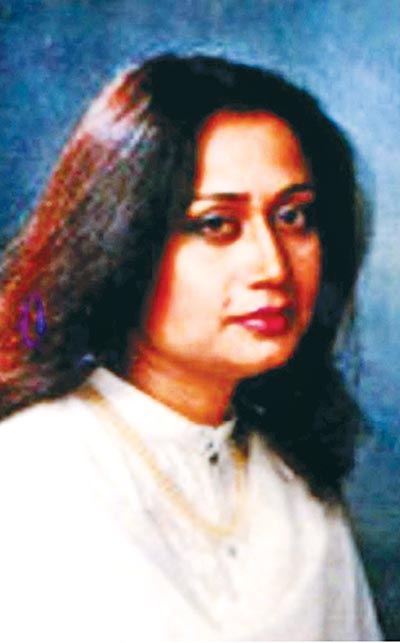 Parveen Shakir was an Urdu poetess, educator and a municipal servant of the Government of Pakistan. She was born on November 24 in 1952 in Karachi, Pakistan. She began composing at an early age and spread her first volume of verse, Khushbu, to incredible recognition, in 1976. She in this way distributed different volumes of verse, all generally welcomed, Sad-barg in 1980, Khud Kalami and Inkaar in 1990, Kaf-e-Aina other than an accumulation of her daily paper segments, named Gosha-e-Chashm, and was granted one of Pakistan's most noteworthy respects, the Pride of Performance for her extraordinary commitment to writing in 1976. The verse books are gathered in the volume Mah-e-Tamaam except for Kaf-e-Aina. Parveen passed away in 1994 in a car accident while on her approach to work.
Parveen Shakir did her matriculation in 1966, intermediate in 1968, B.A (Hons) in 1971 and M.A (English) from Karachi University in 1972. She showed up in CSS in 1982 and secured second position in Pakistan. Parveen Shakir acquired two graduate degrees, one in English Literature and the other one in Linguistics. She additionally held a few degrees and another graduate degree in Bank Administration. She was an instructor for a long time before she joined the Civil Service and functioned in the Customs Department. In 1986 she was delegated as the second secretary, Federal Bureau of Revenue in Islamabad. A remarkable understudy all through, Parveen taught English writing for a long time at Abdullah College in Karachi before joining the civil administrations. In the course of her administration service, she received studentships and chased studies in the West.
Parveen began composing at a youthful age, writing both composition and verse, and donating segments in Urdu daily papers, and a couple of blogs in English magazines. At first, she composed under the pseudonym, "Beena". Parveen Shakir utilised dual types of poesy in her work generally, one being the customary ghazal and the other as free rhyme. The utmost noticeable subjects in Parveen's poesy are affection, feminism, and social humiliations; however she infrequently composed on different points too.
Her work was frequently in light of romance, discovering the ideas of adoration, attractiveness and their flaws, and comprehensively combined the usage of comparisons, allegories and characterizations. Ostensibly, Parveen can be named as the principal lady writer to utilize the word 'girl' in her workings as the male-ruled Urdu verse act sometimes utilizes that word, and uses manly linguistic structure while discussing the beloved one. Correspondingly, she regularly made utilization of the Urdu first-individual, ladylike pronoun in her verses which, however to a great degree basic in composition, was once in a while utilized as a part of verse, even by female artists, afore her.
Parveen Shakir's ghazalyaat are viewed as "a mix of established convention with present day thoughtfulness", and primarily manage the ladylike point of view on affection and sentiment, and related subjects, for example, attractiveness, closeness, parting, terminations, spaces, doubts and unfaithfulness and betrayal. A large portion of Parveen's ghazalyaat comprise five to ten odes, Here and there, two back to back couplets may contrast incredibly in significance and setting, for case, in one of her works, the couplet 'That young lady, similar to her home, maybe/Fell casualty to the surge is quickly trailed by 'I see light when I consider you/Perhaps recognition has turned into the moon'.
When contrasted with her ghazalyaat Shakir's free verse is much valiant, and discovers societal matters and prohibitions, including sexual category, parting, nationalism, hypocritical, prostitution, the human thoughts, and present activities. It is additionally much more current and informed. Parveen Shakir is recognized for having utilized the use of popular ethos orientations and English words and expressions, that have stirred up with Urdu, in her free verse, a preparation that is both by and large viewed as wrong, and condemned, in Urdu verse. A case is the ballad Departmental Store Mein [In a Departmental Store], which is titled along these lines notwithstanding the way that there the term 'departmental store' could undoubtedly have been replaced with its Urdu proportional, and where terms like 'natural pink,' 'hand moisturizer,' "shade," "aroma" and "pack" are brought into utilization, and mentions made to beauty care products brands like, Pearl, Revlon, Elizabeth Arden, and Tulip. Other cases are her ballads Ecstasy, Nun and Picnic. Parveen's free verse additionally holds a couple of attributed interpreted or enlivened works that are ballads that are interpretations of, or enlivened by, different writers. Instances are Wasteland, a lyric roused by Elliot's ballad of a similar name, and Benasab Wirsay Ka Bojh [The Burden of Illegitimate Inheritance], an interpretation of W.B. Yeats' Leda and the Swan.
Parveen Shakir's verse was generally welcomed, and after her awkward demise, she is presently viewed as one of the best and "most noticeable" advanced artists of the Urdu dialect has ever delivered. Addressed as an "extraordinary poetess," her verse has attracted correlations with that of Iranian poet Forough Farrokhzad, and she is deliberated among the type of poets" observed as innovators in resisting custom by communicating the "female experience" in Urdu verse."
Parveen Shakir wedded a Pakistani doctor, Syed Naseer Ali, with whom she had a child, Syed Murad Ali. Unfortunately the marriage did not keep going long and finished in a divorce. On December 26 in 1994, Parveen's car hit with a bus when she was on her way to work in Islamabad. The mishap leads to her decease, an extraordinary misfortune to the Urdu verse world. The street on which the mischance occurred is named after her now (Parveen Shakir Road). At the season of her demise, she was just 42 years of age and her sudden passing was an extraordinary stun to her fans.
The writer is a freelance contributor.
Loading...
Loading...
Also read






Editor : Iqbal Sobhan Chowdhury
Published by the Editor on behalf of the Observer Ltd. from Globe Printers, 24/A, New Eskaton Road, Ramna, Dhaka.
Editorial, News and Commercial Offices : Aziz Bhaban (2nd floor), 93, Motijheel C/A, Dhaka-1000.
Phone: PABX- 41053001-06; Advertisement: 41053012; 01793317829, 01550707291, E-mail: [email protected], [email protected] Online: email: [email protected] 41053014; 01550707297 Advertisement: 01550707296
Published by the Editor on behalf of the Observer Ltd. from Globe Printers, 24/A, New Eskaton Road, Ramna, Dhaka.
Editorial, News and Commercial Offices : Aziz Bhaban (2nd floor), 93, Motijheel C/A, Dhaka-1000.
Phone: PABX- 41053001-06; Advertisement: 41053012; 01793317829, 01550707291, E-mail: [email protected], [email protected] Online: email: [email protected] 41053014; 01550707297 Advertisement: 01550707296


