



| HEADLINE |

|
Firoza Begum, Kamal Dasgupta remembered at Shilpakala Academy
Published : Saturday, 6 July, 2019 at 12:00 AM
Culture Desk


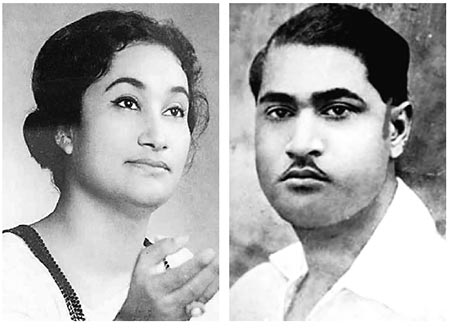 Late eminent Nazrul Sangeet artiste Firoza Begum and music composer-director Kamal Dasgupta were recalled at a memorial programme recently held at Music and Dance Centre of Bangladesh Shilpakala Academy, Segunbagicha in the city. The programme featured discussions, musical soiree and cultural show. The discussion was followed by presentations of Nazrul songs and dance performances.
Professor ABM Nurul Anwar, Nazrul artiste Yasmin Mushtari, singer Badshah Bulbul and music exponent Sohrab Hossain spoke at the event, which was organised by Bangladesh Shilpakala Academy as part of a ten-day reminisce programme.
At the event, singers Fatema Tuz Zohra, Badshah Bulbul and Yasmin Mustari performed.
Feroza Begum was born in Gopalganj District in1930. She became drawn to music in her childhood. She started her career in 1940s. She first sang in All India Radio while studying in sixth grade. She met the national poet Kazi Nazrul Islam at the age of 10. She became a student of him. In 1942, she recorded her first Islamic song by the gramophone record company HMV in 78 rpm disk format. Since then, 12 LP, 4 EP, 6 CD and more than 20 audio cassette records have been released. She lived in Kolkata from 1954 until she moved to Dhaka in 1967.
In 1956, Feroza Begum was married to Kamal Dasgupta, a singer, composer, and lyricist. Their sons----Hamin Ahmed and Shafin Ahmed are musicians. They are the members of the Miles.
Feroza received many awards including Independence Day Award, Netaji Subhash Chandra Award, Satyajit Ray Award, Nasiruddin Gold Medal, Bangladesh Shilpakala Academy Gold Medal, Best Nazrul Sangeet Singer Award, Nazrul Academy Award, Churulia Gold Medal, Gold Disk from CBS, Japan, and more. She died in 2014 in Dhaka.
Kamal Dasgupta was a singer, composer and music director, was born in 1912 in Jessore. He was a versatile musical genius. He sang modern songs in Bengali, Urdu, Hindi, and Tamil. He was also a brilliant composer, composing the music for about eight thousand songs. His work was based on classical music and tended towards the Thungri style, though he also drew inspiration from other sources.
Kamal Dasgupta composed the music for about eighty Bangla films, among them Tufan Mail, Jhamelar Prem, Ei Ki Go Shes Dan. His last film as a music director was Badhu Bharan. He also composed the background music for an American film, War Propaganda. His active life as a composer covered about fourteen years. His unique contribution in music is his invention of a shorthand method for Swaralipi.
In 1935 Kamal Dasgupta joined the Gramophone Company of India as a music director. During his term there, he developed a close association with Kazi Nazrul Islam and composed the music for almost four hundred of his songs. The gramophone records for which Kamal Dasgupta composed music were very popular in the 1950s and 1960s. Among his songs still popular today are 'Sanjher Taraka Ami', 'Prthivi Amare Chay', and 'Ami Bhorer Juthika'. Kamal Dasgupta died in 1974 in Dhaka.
Loading...
Loading...
Also read








Editor : Iqbal Sobhan Chowdhury
Published by the Editor on behalf of the Observer Ltd. from Globe Printers, 24/A, New Eskaton Road, Ramna, Dhaka.
Editorial, News and Commercial Offices : Aziz Bhaban (2nd floor), 93, Motijheel C/A, Dhaka-1000.
Phone: PABX- 41053001-06; Advertisement: 41053012; 01793317829, 01550707291, E-mail: [email protected], [email protected] Online: email: [email protected] 41053014; 01550707297 Advertisement: 01550707296
Published by the Editor on behalf of the Observer Ltd. from Globe Printers, 24/A, New Eskaton Road, Ramna, Dhaka.
Editorial, News and Commercial Offices : Aziz Bhaban (2nd floor), 93, Motijheel C/A, Dhaka-1000.
Phone: PABX- 41053001-06; Advertisement: 41053012; 01793317829, 01550707291, E-mail: [email protected], [email protected] Online: email: [email protected] 41053014; 01550707297 Advertisement: 01550707296


