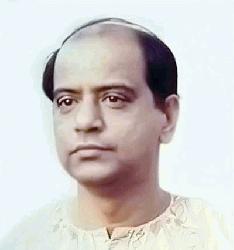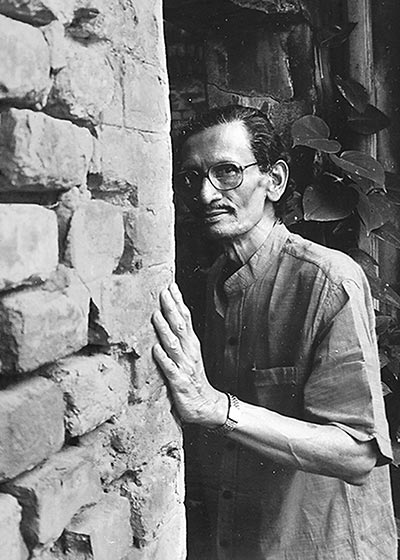
Noted Indian painter Rabin Mondal passed away on July 3 in Pacchim Bangla. He was born as Rabindra Nath Mondal---a painter from Howrah, West Bengal. He was an Indian artist who was a founding member of the Calcutta Painters. He lived and worked in relative obscurity until retrospective exhibitions of his work in Kolkata, New Delhi and Bombay brought him to India's national attention in 2005.
The son of a mechanical draughtsman, Mondal took to drawing and painting at the age of twelve when he injured his knee and was confined to bed. The Bengal famine in 1943 and the Calcutta communal riots of 1946 deeply impacted his psyche, as a result of which he joined the Communist Party and became a Leftist and one-time activist. However, Rabin Mondal's final refuge had been his art as the ultimate weapon of protest.
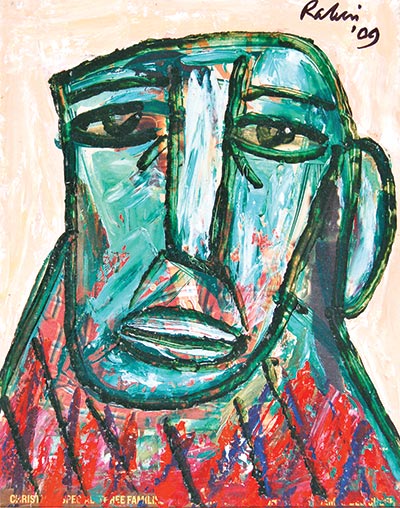
Mondal's art is typically known for its inspiration from primitive and tribal art and for its potent simplifications and raw energy. Some of Mondal's best canvases have an obvious cubist influence, stylistically his work has been predominantly expressionist, a reaction to the tormented humanity that surrounded him in Calcutta, and the tragic events of his formative years. Mondal's figuration derives from a growing abhorrence towards mankind's moral decay in all spheres of life. The cubo-futuristic angularities of forms within the pictorial space arranged around them evolved into a series of paintings depicting highly distinct human figures that struggle to live a hero's life in a mocking but tragic world. Mondal's images have a deeply felt iconic appearance. The series Queen, King, Man represent figures that are static, totemic, tragicomic, ruthlessly shattered and ruined. Having subverted the classical canons of harmony and beauty, Mondal invented a language in paint that could express his anguish and rage towards the decadence and frequent inhumanity he saw. Even the expressionistic use of splattered colours, the bold and enormous application of black, is representative of this symptom.
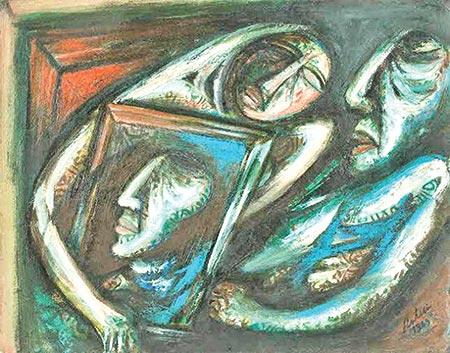
Mondal worked out of his Howrah studio, churning out a series of "kings" and "queens" painted with oil on canvas. These are perhaps Mondal's best known works, depicting tragic looking figures, seemingly suffering from paranoia and fear, yet ironically termed kings and queens. Some of the highlights of this series were the works Man Acting as King, King Being Appeased, King Making Confession, and King and his Assassin. Mondal also produced a series of "deities", which sometimes seem to merge thematically with his "queens". The artist's deities are generally depicted with radiate crowns, whereas his kings and queens are not. Other favorite subjects of the artist were the brothel and the harem, which he depicted in canvases such as Event in Red Light Area and Orgy.
Mondal was born in Howrah, an overcrowded urban extension of Calcutta. His family had prospered in business in the late 19th century. The narrow lane where Rabin's paternal home stands was named after his grandfather Fakirdas Mondal. But the pressures of an extended Bengali household forced the young Rabin to live with not only his brothers and sisters, but also his aunts, uncles, great aunts and uncles, and also his cousins. Though the Mondal family had a highly educated and upper-middle-class background, Howrah was known for its overcrowded slums and impoverished migrant workers who toiled in various grimy industries. It was an environment that caused the young Rabin to take note of the realities of life and its struggles.
Like many Indian artists of his generation, Rabin was deeply affected by the Bengal famine of 1943, the struggle for India's independence, and the subsequent partition of his native Bengal.
Rabin Mondal graduated in Commerce from Calcutta University in 1952. His first formal education in art was at the Indian College of Art and Draughtsmanship, Calcutta. He continued his artistic studies at the Asutosh Museum of Indian Art of the University of Calcutta.
In 1964 Rabin and what is now known as the "Group of Eight", (which consisted of Nikhil Biswas, Prokash Karmakar, Bijan Chowdhury, Gopal Sanyal, Bimal Banerjee, Mahim Rudra, Gunbritt Svensson and Mondal himself) formed the Calcutta Painters. This lively group of artists worked to promote modernist art not only in Calcutta, but throughout India, becoming nationally known in the process.
Rabin had several solo exhibitions: from 1961 - 1973, 1976, 1987, 1993 and 1999 he exhibited solo at various places in Kolkata. In 1974, 1977, 1982, 1983, 1987 and 1991 he showcased solo in several place in New Delhi. From 1978 - 1980 and in 1984 he had solo exhibitions at Birla Academy of Art and Culture in Kolkata. In 1980 he had a solo show at Max Mueller Bhavan, Mumbai. In 1989 and 1990 he exhibited solo in Mumbai. In 1993 he had a solo show at Jehangir Art Gallery, Mumbai. In 2014 - 2015 and 2016 he exhibited 'Kingdom of Exile: A Retrospective' at Delhi Art Gallery, Mumbai and at DAG Modern, New York.
Rabin received many awards--- he won the 'Eminent Painter' award from All India Fine Arts and Crafts Society (AIFACS) in New Delhi in 1996. In 2001 he was given the Abanindranath Puraskar by the Department of Information and Culture, Government of West Bengal in Kolkata.
The writer is a freelance contributor.