



| HEADLINE |

|
Abdur Rahman Chughtai: Allegory and the Imperial Aesthetic
Published : Wednesday, 3 July, 2019 at 12:00 AM
Naser Jamal Khan


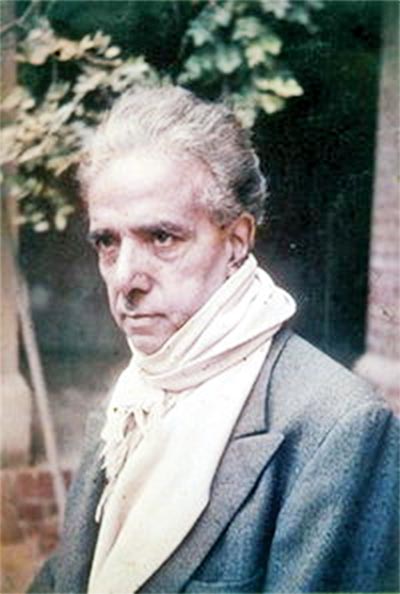 Abdur Rahman Chughtai was a painter and intellectual from Pakistan, who created his own unique, distinctive painting style influenced by Mughal Art, miniature painting, Art Nouveau and Islamic art traditions. He is remembered today as possibly the most distinguished Pakistani artist of the 20th century. His work draws from a shared South Asian cultural heritage, and he was one of the few Pakistani artists to be recognized in India before and after the 1947 partition. He is considered the first significant modern Muslim artist from South Asia, and the national artist of Pakistan. He was given the title of Khan Bahadur in 1934, awarded Pakistan's Hilal-i-Imtiaz in 1960, and the Presidential medal for Pride of Performance in 1968.
Chughtai was a man of many parts. He was a workaholic and multidimensional artist. In his sixty years of artistic creation, Chughtai produced nearly 2000 watercolours, thousands of pencil sketches, and nearly 300 etchings and aquatints. He also wrote short stories, and articles on art. He designed stamps, coins, insignia and book covers. He was also an avid collector of miniatures and other art. He published three books of his own work: the Muraqqai-i-Chughtai, Naqsh-i-Chughtai and Chughtai's Paintings.
Chughtai was born in Lahore in 1897, the second son of Karim Bukhsh, in a family descended from generations of craftsmen, architects, and decorators. Chughtai briefly learnt Naqqashi from his uncle Baba Miran Shah Naqqash at a local mosque. After completing his education at the Railway Technical School in Lahore, Chughtai joined the Mayo School of Art, where Samarendranath Gupta, a pupil of Abanindranath Tagore was Vice-Principal. After leaving the school, he made a living for a while as a photographer and drawing teacher. He eventually became the head instructor in chromo-lithography at the Mayo School.
In 1916, Chughtai's first painting in a revivalist oriental style appeared in the Modern Review. He had his first exhibition in 1920 at the Punjab Fine Art Society. He also exhibited with the Indian School of Oriental Art during the 1920s, by which time he had become quite renowned. His work contributed greatly to Lahore's burgeoning modern art scene. Whilst he predominantly worked with watercolors, Chughtai was also a print-maker, perfecting his etching skills in London during visits in the mid 1930s. By the 1940s Chughtai had created his own style, strongly influenced by Islamic art traditions, but retaining a feel of Art Nouveau. His subject matter was drawn from the legends, folklore and history of the Indo-Islamic world, as well as Punjab, Persia and the world of the Mughals.
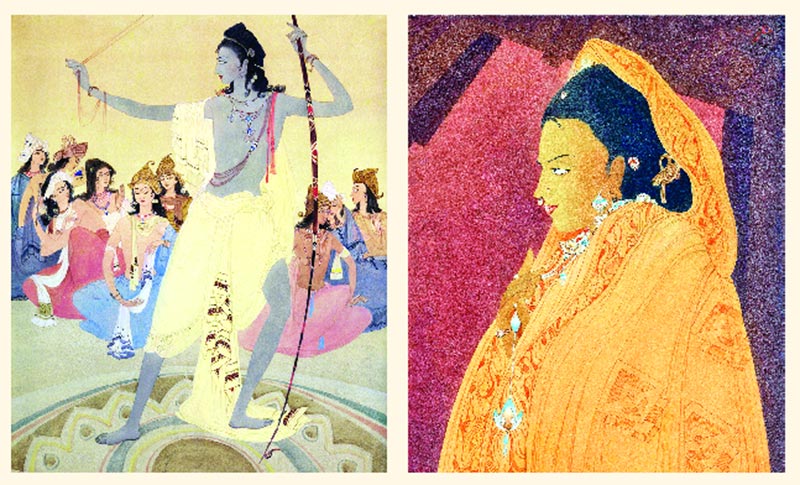
Untitled-1.jpg
After the creation of Pakistan in 1947, Chughtai came to be regarded as one of the most famous representatives of Pakistan. Chughtai's paintings were gifted to visiting heads of states. Allama Iqbal, Pablo Picasso and Elizabeth II were said to be amongst his admirers.
Often construed as a nationalist painter - indeed, Chughtai was Pakistan's first national art icon - his work has been convincingly interpreted as espousing a kind of Islamic cosmopolitanism envisioned by the prominent poet-philosopher Muhammad Iqbal and was intimately tied to the politics of pre-Partition Muslim self-determination. Lahore's cultural and intellectual elite vigorously participated in nationalist and separatist movements and no doubt informed Chughtai's early rejection of the modernism emanating from Europe and the US. Dreaming of a Muslim-Indian art separate from Western influences, the artist internalised the art history of the Sub-continent and Persia instead and, crucially, advocated the quintessential hybridity of Mughal art as the bedrock for the evolution of an indigenous artistic identity.
Chughtai has extensively showcased his work worldwide. Numerous works of his are held in private and public collections all over the world.
The writer is a freelance contributor.
Loading...
Loading...
Also read




Editor : Iqbal Sobhan Chowdhury
Published by the Editor on behalf of the Observer Ltd. from Globe Printers, 24/A, New Eskaton Road, Ramna, Dhaka.
Editorial, News and Commercial Offices : Aziz Bhaban (2nd floor), 93, Motijheel C/A, Dhaka-1000.
Phone: PABX- 41053001-06; Advertisement: 41053012; 01793317829, 01550707291, E-mail: [email protected], [email protected] Online: email: [email protected] 41053014; 01550707297 Advertisement: 01550707296
Published by the Editor on behalf of the Observer Ltd. from Globe Printers, 24/A, New Eskaton Road, Ramna, Dhaka.
Editorial, News and Commercial Offices : Aziz Bhaban (2nd floor), 93, Motijheel C/A, Dhaka-1000.
Phone: PABX- 41053001-06; Advertisement: 41053012; 01793317829, 01550707291, E-mail: [email protected], [email protected] Online: email: [email protected] 41053014; 01550707297 Advertisement: 01550707296


