



| HEADLINE |

|
Historic ‘Manasa Bari’ of Shariatpur on verge of collapse
Published : Tuesday, 2 July, 2019 at 12:00 AM
Our Correspondent


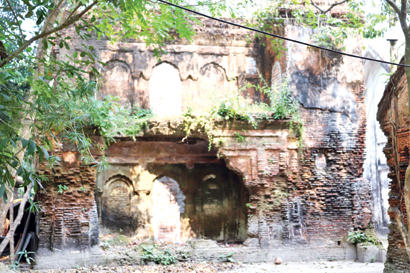 SHARIATPUR, July 1: About 600-year-old heritage 'Manasa Bari' or 'Mayurvatta's Bari' at Dhanuka Village under Sadar Upazila of the district is on the verge of collapse due to lack of renovation and preservation.
 'Manasa Bari' is located just behind local police super's office.
Shyamapada Chakrabarty, Mayurvatta's last successor, said most of the land of this house has been lost and grabbed by the influential people. If the government does not preserve this property, it will become extinct in future.
He also said "Manasa Bari" was established on a property of almost seven acres. Some influential people have occasionally pressured him to knock down these buildings.
He further said he has preserved these medieval institutions even in the face of immense pressure.
Gobinda Chandra Chakrabarty, son of Shyamapad Chakrabarty, said many journalists, tourists and researchers came to receive information about the tradition of this house.
However, no one has taken any action to protect this ancient heritage. If this asset is preserved, Dhanuka Manasa Bari can be established as one of the key tourist centres in the district.
Deputy Commissioner Kazi Abu Taher said, "We have sent a letter to the Department of Archaeology regarding the renovation and maintenance of Manasa Bari."
A large pond is situated on the right side of the entrance of the Manasa Bari. The borders to the main house began from the west bank of the pond. At present, a total of five structures are still standing: 1) Kali Mandir, 2) Durga Mandir, 3) Manasa Mandir, 4) Nahabat Khana, and 5) Sangskrit School.
Near the western border of the house, facing on the east, there is a monument with a bungalow style two-way sloping roof, which was once used as the Manasa Mandir.
Another bigger edifice is situated on the northern border, facing on the south, which also has a two-way sloping roof.
The monument has been marked as Durga Mandir. There is another two-storied building, locally known as the Nahabat Khana, facing the temple, which has ruined mostly.
There is a two-storied temple of the Goddess Kali, adjacent to the west side of the manor's courtyard.
A lot of the second floor and parts of the first floor of the temple have collapsed. Another two-storied building, which has survived on the southwest area, was used as a Sanskrit School. Next to the school, there was the residence of Acharya family.
According to the nameplate of the Manasa Bari, these buildings were built in 1,400 AD. Former Chairman of Archaeology Department of Jahangirnagar University Dr Shahnewaz said, there are no inscriptions that elucidate the construction period of these buildings. Nonetheless, seeing the construction style, it is believed that they were either built at the end of the Sultanate Period or the early Mughal period.
The construction style is such that there are several doors arched to enter the room from the rear of the building. These medieval monuments were built with limestone and bricks.
There are also traces of Islamic architecture in the construction style of these structures. The institution and the temple might have been built in late 16th or early 17th century.
Local sources said the Sangskrit School building has underground cells, but it is impossible to prove its authenticity without an archaeological excavation.
An excavation project was initiated by the authorities and later abandoned. However, after a little digging, evidence of a brick-lining was found deep inside the ground.
The facade of the building is greatly damaged and the inner chamber walls have smooth plaster. There is no decoration on the wall, but there are light and simple notched designs on the walls.
There are also arched alcoves in every two-or-three feet on the wall. The architectural excellence of Manasa Bari proved that there was a rich past and culture in this region.
With the existence of the educational institution in Manasa Bari, it appears that during the contemporary period, a cultural circle was formed in this region where the people of Munshiganj, Cumilla, Chandpur, Madaripur, Faridpur, Barishal, Gopalganj and other places came to learn Sangskrit.
According to the previous history of Manasa Bari, Mayurvatta's daughter Jayanti Devi or Vaijayanti was a Sangskrit poetess.
She received Sangskrit education from her father Mayurvatta, and achieved special knowledge in scripture about conciliation.
Vaijayanti's husband was born in the famous Pandit family of Kotalipara in present Gopalganj. Her husband Krishnanath Sarvabhouma was also a Sangskrit poet.
Temples of Manasa Bari have some significant features of the ancient era. There are 11 ornamental tiles under the roof of the temple, and a big lotus in between each tile.
The flower and sapling designs on a flower vase, situated on a pillar near the main entrance of the Durga Temple, and under its rooftop panel, are simply remarkable.
Colour tiles were used on the walls of the eastern side of this temple. The use of these motifs was commonplace during the Mughal era, according to the former Chairman of Archaeology Department of Jahangirnagar University Dr Shahnewaz.
Local and historic descriptions said, the descendants of Mayurvatta came to reside in the Manasa Bari from Kannauj to present-day Dhanuka of Shariatpur District.
Lakshman Mishra was shown as the descendant of Mayurvatta in their family tree.
After Shyamol Sen, second son of the King of Sen Dynasty, conquered Kotalipara, he brought a Brahmin named Yashdhar Mishra with him.
Meanwhile, a sorceress died in Bikrampur, befalling an inauspicious haze over the kingdom. The king decided to call his priest to sacrifice all other sorceresses, when Yashdhar pointed out the fault in the idea.
The king then asked Yashdhar to carry out the sacrifice. When he concluded it successfully, Yashdhar was rewarded heartily by the king. He started living on the land rewarded to him by the king, and the king brought more Brahmins from Kannauj so that Yashdhar feel at ease living there.
Lakshman Mishra is a successor of these Brahmins, but he left Bikrampur because of river erosion and moved to Dhanuka. Meanwhile, it is believed that Mayurvatta and Lakshman Mishra, together, built the structures of Manasa Bari at the end of the 15th century.
There were some ancient myths regarding 'Manasa Bari'. It was firstly known as Mayurvatta's house. According to Shyamapada Chakrabarty, and other sources, the first myth says that Mayurvatta's parents, the Bhattacharya family, was on a pilgrimage to Kashidham, when Mayurvatta's mother gave birth to him inside a forest.
The Brahmin family believed that religion was their priority, rather than their new born child. Thus, the family set off for their journey once again, leaving the infant in the forest, covered with sal leaf.
Once their pilgrimage concluded, a deity came to Bhattacharya, in his dreams, saying that their prayers would not be accepted as they were wrong to leave their child unprotected.
Realising their mistake, the couple returned to the forest and found a peacock covering their son with its feathers. Hence, Mayurvatta was named after the "mayur," or peacock that sheltered him, and the area later became the house of the ancient Sanskrit scholar and poet.
The second legend tells the story of a teenager who had a habit of collecting flowers from the garden of Manasa Bari at dawn. One day, the teenager found a massive serpent in the garden and returned home frightened. When he went to the garden the next day, he faced the snake again, but this time it followed the teen to his house.
The snake slithered around the boys in a dance in the presence of terrified onlookers. Later at night, the Manasa Goddess came to the dreams of the household members, and instructed them to worship the goddess, thus establishing the Manasa temple in the house.
Since then, Mayurvatta's house has been named as Manasa Bari.
Locals said if the historic site is renovated and preserved, it can become a tourist spot in the district.
Loading...
Loading...
Also read


Editor : Iqbal Sobhan Chowdhury
Published by the Editor on behalf of the Observer Ltd. from Globe Printers, 24/A, New Eskaton Road, Ramna, Dhaka.
Editorial, News and Commercial Offices : Aziz Bhaban (2nd floor), 93, Motijheel C/A, Dhaka-1000.
Phone: PABX- 41053001-06; Advertisement: 41053012; 01793317829, 01550707291, E-mail: [email protected], [email protected] Online: email: [email protected] 41053014; 01550707297 Advertisement: 01550707296
Published by the Editor on behalf of the Observer Ltd. from Globe Printers, 24/A, New Eskaton Road, Ramna, Dhaka.
Editorial, News and Commercial Offices : Aziz Bhaban (2nd floor), 93, Motijheel C/A, Dhaka-1000.
Phone: PABX- 41053001-06; Advertisement: 41053012; 01793317829, 01550707291, E-mail: [email protected], [email protected] Online: email: [email protected] 41053014; 01550707297 Advertisement: 01550707296


