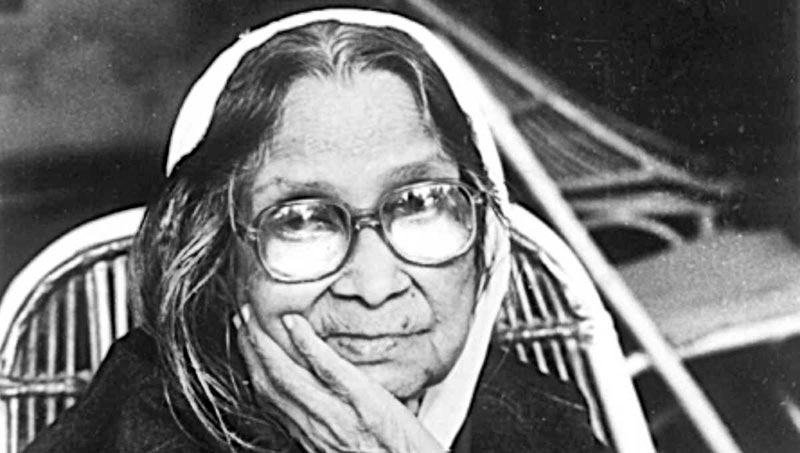
Today marks the 108th birth anniversary of Sufia Kamal, a renowned poet and a pioneer of women's rights movement in Bangladesh. On the occasion, different socio-cultural organizations will arrange various programmes, including discussion and cultural function, to pay tribute to the poet.
Sufia Kamal was born to Shayestabad's Nawab family in Barisal in 1911. She not only witnessed great changes in society and history but also influenced the positive transformation of the status of women as well as the Bangladeshi society. This iconic figure dedicated her life to empowering women. She was at the forefront of all political, social and cultural movements during her lifetime to establish human rights and achieve women's emancipation.
During her childhood, women's education especially for Muslims was prohibited. Sufia Kamal was taught to read and write Bengali by her mother. This opened a new world to her and the family library proved to be a treasure trove where she could spend considerable time. Whatever little learning all these highly disorganised, non-formal methods offered; Sufia Kamal took full advantage of those. At the age of 12, she got married to Syed Nehal Hossain, her cousin.
After this, Sufia Kamal left Shaistabad and settled in Barisal, the district town. Her husband was an aspiring writer associated with a literary journal. The town life offered her an opportunity to come out of home, of course with proper veil, and get involved in social work along with the progressive Brahma women. She also took part in the non-cooperation movement called by Mahatma Gandhi and woven thread on charka as a mark of protest. Inspired by her husband, she wrote a short-story Sainik Badhu and a few poems which were published in a literary journal. She got involved in literary activities, came to know Kazi Nazrul Islam, the Rebel Poet (1899-1976) and Mohammad Nasiruddin (1888-1994), a great patron of Muslim authors. Nasiruddin, the editor and publisher of Showgat, a literary journal that promoted young and upcoming writers, inspired Sufia Kamal to engage herself into writing. Sufia put much effort in reading books and sharpened her writing style. She also had a very short but fruitful contact with Rokeya Sakhawat's social organisation promoting awareness among women, especially in the slums.
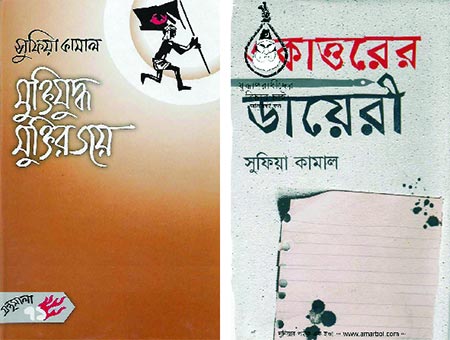
She published her first story at 14, and her prose and poems drew favorable notice. Some works were aimed at children. Some were translated into English and Russian. Increasingly, she wrote against religious communalism, fundamentalism and superstitions. She promoted democracy and women's emancipation. "The culture was to keep the women at home, train them in household chores and make them perfect women: docile, ready to please everyone in the family," she said in an interview. "There was a strong anti-British movement, and my family also believed that women should stay out of it. But I had an indomitable nature and I crossed my limits to get a taste of all there was. I was allowed to learn Arabic and a little Persian, but not Bengali. I made it a point to learn Bengali from people working in the house." That became the language she used for her writing.
Sufia Kamal was blossoming in Kolkata with active support of her husband, trying her hand in creative writing and getting involved with social work, a great disaster struck her. Her husband died of tuberculosis in 1932. After five years of his death Sufia was married to Kamaluddin Ahmed.
In addition to her first daughter, Sufia had two other daughters - Sultana Kamal and Saida Kamal and two sons - Shahed Kamal and Sajed Kamal.
Sufia's first poem, Bashanti, was published in Saogat magazine in 1926. In 1931, she became the first Bengali Muslim female to be the member of Indian Women Federation
She took part in all political movements that defined the future of the country since 1947. Her role in the struggle leading to the 1971 Liberation War, anti-autocratic movement in 1990 and the anti-collaborator movement in 1992 are memorable. Sufia was instrumental in establishing the Bangladesh Mahila Parishad, Chhayanaut and Kachi Kanchar Mela.
She received the Independence Day Award, Ekushey Padak, Bangla Academy Award, Deshbandhu CR Das Gold Medal, and many other national and international accolades.
The writer is a freelance contributor.