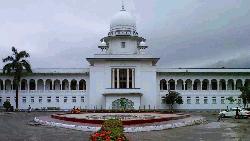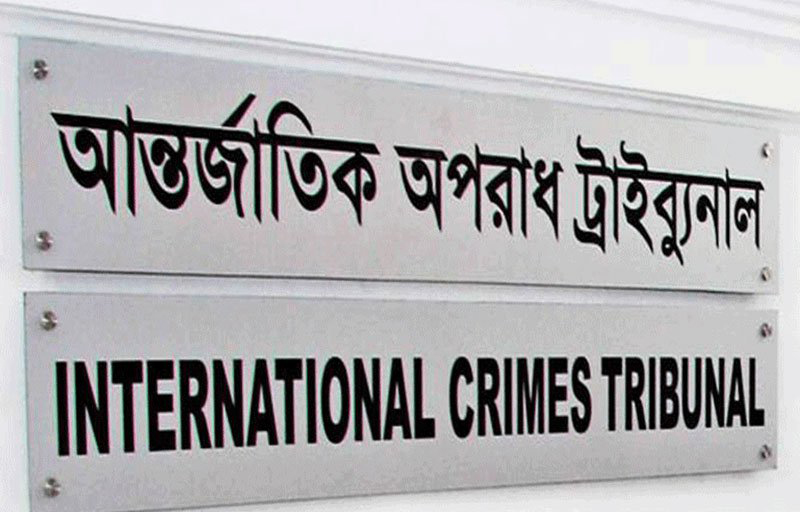
The International Crimes Tribunal (Bangladesh) (ICT of Bangladesh) is a domestic war crimes tribunal in Bangladesh set up in 2009 to investigate and prosecute suspects for the genocide committed in 1971 by the Pakistan Army and their local collaborators, Razakars, Al-Badr and Al-Shams during the Bangladesh Liberation War. During the 2008 general election, the Awami League (AL) pledged to try war criminals. The government set up the tribunal after the Awami League won the general election in December 2008 with a more than two-thirds majority in parliament.
The events of the nine-month conflict of the Bangladesh Liberation War are widely viewed as genocide; the Pakistan Army and collaborators targeted mass people, intellectuals and members of the political opposition for attacks. Historians have estimated that, during the conflict, between two hundred thousand and four hundred thousand women and children were raped leading to an estimated 25,000 war babies being born. Estimates of persons killed during the conflict range to three million. An estimated ten million refugees entered India, a situation which contributed to its government's decision to intervene militarily in the civil war. Thirty million people were displaced.
Seeing the broad support for war crimes trials, the Awami League-led fourteen-party alliance included this in their election platform. The Four-Party Alliance, including the BNP and Jamaat-e-Islami, had several alleged war criminals among their top-ranking politicians.
The former freedom fighters and sector commanders of the liberation war pleaded with citizens against voting for the alleged war criminals. The fourteen-party alliance won the election on 29 December 2008, with an overwhelming majority, a "historic landslide". This was thought to be due to their commitment to prosecute war crimes.
On 29 January 2009, Mahmud-us-Samad Chowdhury, a member of the parliament (MP) from the Awami League (AL), proposed taking action to establish a tribunal to prosecute war crimes during a session of the Jatiyo Sangshad. A resolution was passed unanimously calling on the government to proceed as promised in the election.
In 1973 the newly independent government of Bangladesh passed a law, the International Crimes (Tribunals) Act (ICT Act 1973), to authorise the investigation and prosecution of the persons responsible for genocide, crimes against humanity, war crimes and other crimes under international law committed in 1971. The act was a complete in itself.
On 25 March 2009 the government voted to try the war criminals according to the ICT Act of 1973 but planned amendments to bring the law up to date and in keeping with international standards for similar trials. As a part of the amendment procedure, the government sent the act to the Law Commission, where it was scrutinised by specialist lawyers, judges and professors of the universities. On 9 July 2009, Parliament amended the act as recommended by the commission.
The amendments provided that a political party that had worked against the liberation of Bangladesh could be tried on the same charges as individuals. They also authorised the government to file appeals with the Appellate Division if the tribunal ruled for acquittal for a suspect. The International Bar Association has stated that the "1973 Legislation, together with the 2009 amending text, provides a system which is broadly compatible with current international standards."
On 25 March 2010, the government announced the formation of the following: a three-member judges' tribunal, a seven-member investigation agency, and a twelve-member prosecution team to hold the trials according to the ICT Act of 1973. This landmark announcement was made on the 39th anniversary of the Operation Searchlight massacre by the Pakistan Army on 25 March 1971.
The three judges appointed were Mohammed Nizamul Huq as chairman, with A.T.M. Fazle Kabir and A.K.M. Zahir Ahmed.
Persons appointed to the investigative agency to assist state prosecutors were Abdul Matin, Abdur Rahim, Kutubur Rahman, ASM Shamsul Arefin, Mir Shahidul Islam, Nurul Islam and M. Abdur Razzak Khan.
Golam Arif Tipu was named as Chief Prosecutor. The others are Syed Rezaur Rahman, Golam Hasnayen, Rana Das Gupta, Zahirul Huq, Nurul Islam Sujan, Syed Haider Ali, Khandaker Abdul Mannan, Mosharraf Hossain Kajal, Ziad Al-Malum, Sanjida Khanom and Sultan Mahmud Semon.
The first nearly dozen men indicted include nine leaders of Jamaat-e-Islami, the largest Islamist party in the nation and opposed to independence in 1971: Ghulam Azam, in 1971 chief of the erstwhile East Pakistan unit of the party; incumbent chief Matiur Rahman Nizami, deputy Delwar Hossain Sayeedi, secretary general Ali Ahsan Mohammad Mojahid; assistant secretary generals Muhammaad Kamaruzzaman and Abdul Quader Molla; media doyen Mir Kashem Ali, who heads the pro-Jamaat Diganta Media Corporation; Miah Golam Parwar; and Abul Kalam Azad, an Islamic cleric formerly associated with the party.
Two leaders of the opposition Bangladesh National Party were also indicted: former government ministers Salahuddin Quader Chowdhury and Abdul Alim.