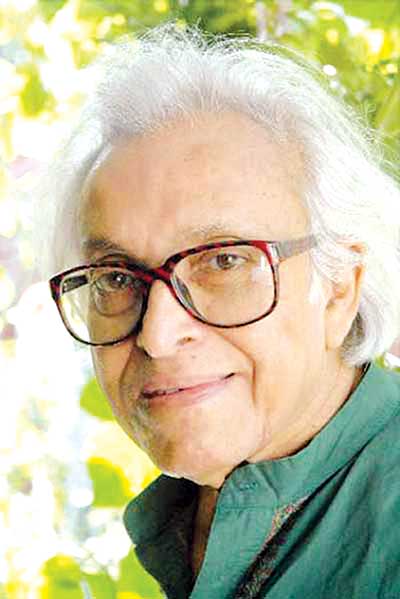
Shamsur Rahman (23 October 1929 - 17 August 2006) who emerged in the latter half of the 20th century wrote more than sixty books of poetry and is considered as one of the key figures in Bengali literature.
Shamsur Rahman was born in his grandfather's house no. 46 in Mahut-Tuli, Dhaka. His paternal home is situated on the bank of the river Meghna, a village named Pahartoli, near the Raipura Police Station in Narshingdi district.
While studying English literature at the University of Dhaka, he joined a student group known as Progressive Writers and Artists Association, reading his verse at Madhu's Canteen and staunchly supporting the movement to retain Bengali as the official language of East Pakistan (now Bangladesh).
October 23 marked the 89th birth anniversary of the pre-eminent poet Shamsur Rahman. He was noted as an urban poet, columnist and editor. Major themes in his poetry and writings include liberal humanism, human relations, romanticism, democracy, religious fundamentalism and more.
The bard was born in his grandfather's house in Dhaka. His paternal home is situated on the bank of the river Meghna in Narshingdi district. He was the fourth of thirteen children. He passed matriculation in 1945. Later he took his I.A. as a student of Dhaka College. The poet started writing poetry at the age of 18, just after graduating from Dhaka College. He studied English Literature at Dhaka University for three years. After a break, he received his B.A. in 1953. He also received his M.A. in the same subject.
The bard wrote more than 60 books of poetry. His first book of poetry, "Prothom Gaan Dwitio Mrittyur Agey," was published in 1960. He witnessed the political turbulence of the 60's and 70's, which reflected in his poems clearly. He wrote his famous poem "Asad-er Shirt" as a tribute to the mass uprising of 1969. During the Liberation War he wrote a number of poems, which brilliantly articulated the aspiration of a nation fighting for its existence.
The poet had a long career as a journalist and served as the editor of a national daily, Dainik Bangla and the weekly Bichitrain the 1980s.
About Shamsur Rahman, renowned poet Muhammad Samad said, "Rahman was undoubtedly one of the foremost Bengali poets. I had spent a fair share of time with him at seminars, recitations, tours overseas and cultural programmes. I fondly remember our times together. His poems and essays motivated people during historic movements. His immense contribution to Bangla poetry during the Liberation War is really praiseworthy. He was mainly recognised for his choice of words and phrases. Throughout a career spanning over six decades, he wrote numerous poems and published over a 100 books. His poetry remarkably articulates urban alienation. He was deeply influenced by Jibanananda Das and Sudhindranath Datta."
Internationally acclaimed Bangladeshi poet Aminur Rahman said, "Rahman was very reserved, soft spoken and belonged to an altogether different world. He was always against communal force and religious bigotry. His works (both poems and essays) highlighted the needs and issues faced by the masses and their way of life. Rahman's poems are courageous; patriotism and political ambiance recurrently got the focal point. An introvert by nature, he became an outspoken liberal intellectual in the 1990s against religious fundamentalism and reactionary politics in Bangladesh."
The poet is also remembered as the "unofficial poet laureate of Bangladesh." Rahman published more than sixty books of poetry, ranging from love sonnets to patriotic verse to whimsical lines about his cat. His well-known 1971 poem, "Shadhinota Tumi" ("Ode to Freedom") was written in the throes of Bangladesh's battle for independence from Pakistan.
His life and work earned him numerous accolades including the Shadhinota Award, the highest honour given by the government of his beloved homeland. The poet also received many prestigious awards in his life time. Rabindra Bharati University and Jadavpur University of India conferred honorary D.Lit. degrees on him. He was a recipient of Ekushey Padak, Adamjee Puroshkar, Bangla Academy Puroshkar, Jibanananda Puroshkar, Kabitalap Purosker, Abul Munsur Gold Medal, Bhasani Puroshkar and more.
The poet passed away in 2006.
The writer is a freelance contributor.





