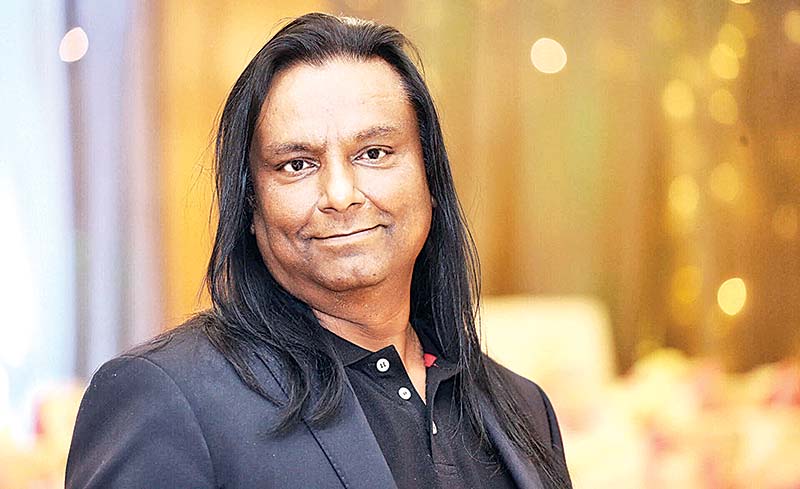
Mustapha Khalid Palash is one of the most illustrious names in the
territory of contemporary architecture of Bangladesh. His novel and
refreshing approach towards architecture makes him peerless or
practically singular in our country. His constructions are noted for
their modern style, and verge on experimentalism. He has designed many
mega buildings in different categories like corporate offices, hotels,
hospitals, residential apartments and more. The recurrent feature of his
architectural work is plain view and easy accessibility of air and
light. Above all, his work carries a modern touch and has proportional
quality. His novel touch and distinct features in architecture have
taken the capital city to a different dimension by creating aesthetic,
sustainable and functional architecture, constructed one after another
for the last one and a half decades. He uses glass and aluminum
extensively in his works. He has a balanced and rational approach
towards the use of space. One can feel like he/she is outdoors when
entering one of his buildings. His use of water in his projects is also
environment friendly. "Treading towards architecture, I have fallen
in love with art. I was fond of art from my childhood," says Palash. "I
did not want to become an architect. I wanted to become a painter. But I
was familiar with the financial hardships they face, as both of my
parents were painters. I can't tell you how many times I heard the
reprimand, 'Stop doodling and get to work', when I was a child," he
continues. He is now the Managing Director of Vistaara Architects Ltd
and chairman of the
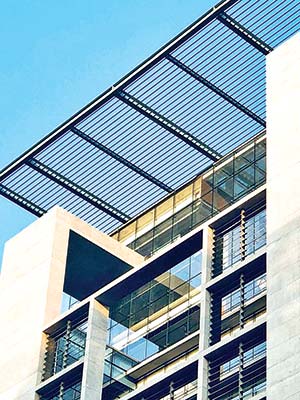
Eastern Bank Head Headquarter (Gulshan)
Delvistaa Foundation. During
his childhood, architecture did not draw Palash's attention as an art
form. When he was in class eight, he made a model of an airport just by
looking at a picture of an airport. That's how Palash became attracted
to architecture and eventually became an architect. He says, "I never
understood what architecture was; I got myself involved in architectural
designs in my boyhood without even realising." Palash graduated from
the Department of Architecture, Bangladesh University of Engineering
and Technology (BUET) in 1988. In 1994, he joined the department as a
teacher and taught there for about five years. In 1998, he opened his
own architectural design firm. During 1988-1999, he spent his career as a
professional architect and teacher. The most significant event at that
time was his trip to Japan where he gained many experiences and watched
different technical aspects of architecture. During that visit, he saw
some projects by Tadao Ando, a veteran architect of Japan. He noticed
the Japanese construction technology as well. That was an eye opener for
him. It is very significant that during his student years he took
architecture assignments. The talented architect says, "I don't know how
much of the urge to create architecture was there. Later when I started
teaching, I always thought that I was working with a group of
researchers which helped me gain my practical experience. In the initial
stage, there was a lack of maturity which each and every architect
faces. That maturity came to me after ten years." About Palash's
architecture and his mode of expression, prominent architect Shamsul
Wares says, "Palash's works carry the attitude of modern
architecture.There is no decoration or ornamentation in his work." Wares
also feels that transparency and ample light, both are vital features
in his work. The distinctness of his work is easily noticeable. His
works don't have any complexity; his language is simple, easily
understandable, communicable and accessible, according to Wares. For
this reason, one can easily appreciate his creations. From the street,
his works look very inviting, attractive and appealing. Pedestrians
enjoy the urban texture in the metropolitan setting. "Air, light and
proportion are easily articulated in his work. He is also conscious
about our climate and weather. But his works look impersonal; our
culture as well as historical elements need to be connected to his
work," he opines.
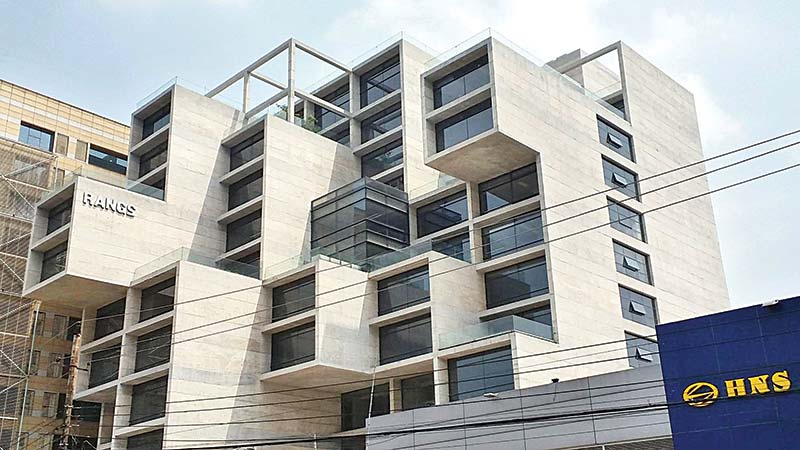
Rangs Babylonia (Tejgaon)
Palash
feels that the number of non-commercial architecture such as museums,
art galleries, educational institutions and libraries, is very
insignificant in our country. The genres of architecture we see are very
few. He thinks that the state should act as a patron to this field more
in the future. He adds that the art of architecture of our country is
now fully depended on developers and corporate houses. "Developers
usually take help from architects for the sake of their own benefit. The
profession of architecture is now a full-fledged one but the
representation is not quite fair," he says, "Public buildings are
neglected." He also points out the fact that architects are very busy
with commercial structures nowadays and that commercial ventures are
more visible in the city. "The government should encourage talented
architects to articulate their creativity and artistic endeavours." Grameenphone
Corporate Head Quarter is one of the good examples of modern
architecture that Palash designed. This project received the Holcim
Green Award. About the project, Palash says, "The project features two
complementary office wings, one being aligned with western boundary,
resulting in a gentle asymmetry in composition and connecting a central
communal space of courtyard of link-bridges, elevators and stairs." The
symbolism and modernity in his work are based upon a contemporary
interpretation of the context, our culture, values and history.
Grameenphone Corporate Head Quarter thus, has the potential for becoming
a new example of a more contemporary, climate and ecologically and
socially responsive design. "The design is civic-minded in its creation
of the plaza at the civic interface, and in its detailed attention to
its immediate landscape-water, central courtyard, and garden at the
extreme south," he says. Palash's notable designs include Bashundhara
City (Pantapath), Grameenphone Corporate Head Office (Bashundhara),
Eastern Bank Head Headquarter (Gulshan), BTI Land Mark (Gulshan), JAS
Cube (Gulshan), Rangs Sultan (Dhanmondi) Banglalink Head Office, the
Robi Head Office, Radisson Bay View Hotel (Chittagong), The Westin Hotel
(Gulshan), and the Lab Aid Cardiac Care Hospital (Dhanmondi) , Shanta
Western Tower (Tejgaon-Gulshan Link Road), Rangs Babylonia (Tejgaon
I/A), Yunusko Tower (Chittagong), PICL Headquarter (Motijheel) and more. Palash
received several national and international awards among which are the
IAB Design Award 1998, Architect of the Year 2005 (India), Burgers Award
for Excellence on Architecture 2007, Holcim Green Built Bangladesh
Prize 2010, Shilpacharya Puroshkar 2011 and more. His works have been
reviewed in several national and international magazines including the
McGraw-Hill publication, Dezeen Magazine, POL Oxygen, and many others. Palash�s mode of painting Since
the late '80s, Mustapha Khalid Palash has been active in the
Bangladeshi art circles. His work is represented by pure abstraction in
its diverse styles. His paintings feature various architectural designs
and shapes. He has freedom to identify himself with his working styles
that are apparently synchronised and technically phenomenal. He strives
to proceed with a certain style that can become a personal hallmark of
his works. Palash's novel approach towards architecture makes him
peerless or practically singular in our country. In his paintings,
vivacious colours and fragmented shapes present a kaleidoscopic
revelation. In Wassily Kandinsky's description of art, the inner element
is most important, without it, no work of art can exist. Palash blends
emotion and intelligence in his paintings and his mode of expression is
considered to be abstract expressionism. His works appear to be
sparkling and dynamic because of the use of deep colours, profuse shades
and evocative lines. In fact, his rectangular and vertical lines create
amazing rays with each ray possessing an individual look. His paintings
are lavish with semi-amorphous and semi-crystalline images. But this
approach does not hamper the viewers' perception of the artist's
feelings and thoughts. Palash's lines signify the modern mode of
expression. A number of his paintings feature varied structures, ovals,
encircled forms. The paintings clearly endorse his architectural
experiences over the years. It is believed that Palash constructs a form
or composition and then he deconstructs it, only to recreate it.
Well-drawn shapes, sharply outlined, and meticulously created textures
make most of his images memorable. Palash's
images also ardently capture fragmented visions inspired by
expressionism. The artist did many paintings where forms of
disintegration were highlighted. His works also highlight a combination
of contemporary geometric shapes and multi-coloured forms. The artist
has used forms and lines derived from his whimsical visions. Most of
his paintings are oil based. Bangladeshi painters infrequently use this
medium mainly due to its high-price and excessive humidity in our
weather. Oil paint gives a richness and profundity of colour that is
unsurpassed by any other medium but is inherently more difficult to work
with. Palash is one of the very few in the Dhaka art scene who works in
this elegant, expensive and arduous medium. The painter has been able
to overcome these limitations with his considerable effort and
devotion.0 Palash's present works break new ground for demonstrating
open space and technical aspects. The paintings seem more concise and
technically phenomenal than ever before. His previous works looked more
rigid and forms as well as composition appeared stuffy. It is noticeable
that Palash is meticulous about using space and he superbly
demonstrates forms according to the aesthetic requirement of the
paintings. The paintings represent emotion and sentiment in a manner
that the artist wants to be universally understood, but in a
non-figurative mode.
Published by the Editor on behalf of the Observer Ltd. from Globe Printers, 24/A, New Eskaton Road, Ramna, Dhaka.
Editorial, News and Commercial Offices : Aziz Bhaban (2nd floor), 93, Motijheel C/A, Dhaka-1000. Phone: PABX- 41053001-06; Online: 41053014; Advertisement: 41053012.
E-mail: district@dailyobserverbd.com, news@dailyobserverbd.com, advertisement@dailyobserverbd.com, For Online Edition: mailobserverbd@gmail.com



 Palash
received several national and international awards among which are the
IAB Design Award 1998, Architect of the Year 2005 (India), Burgers Award
for Excellence on Architecture 2007, Holcim Green Built Bangladesh
Prize 2010, Shilpacharya Puroshkar 2011 and more. His works have been
reviewed in several national and international magazines including the
McGraw-Hill publication, Dezeen Magazine, POL Oxygen, and many others.
Palash
received several national and international awards among which are the
IAB Design Award 1998, Architect of the Year 2005 (India), Burgers Award
for Excellence on Architecture 2007, Holcim Green Built Bangladesh
Prize 2010, Shilpacharya Puroshkar 2011 and more. His works have been
reviewed in several national and international magazines including the
McGraw-Hill publication, Dezeen Magazine, POL Oxygen, and many others. Palash's
images also ardently capture fragmented visions inspired by
expressionism. The artist did many paintings where forms of
disintegration were highlighted. His works also highlight a combination
of contemporary geometric shapes and multi-coloured forms. The artist
has used forms and lines derived from his whimsical visions.
Palash's
images also ardently capture fragmented visions inspired by
expressionism. The artist did many paintings where forms of
disintegration were highlighted. His works also highlight a combination
of contemporary geometric shapes and multi-coloured forms. The artist
has used forms and lines derived from his whimsical visions.


