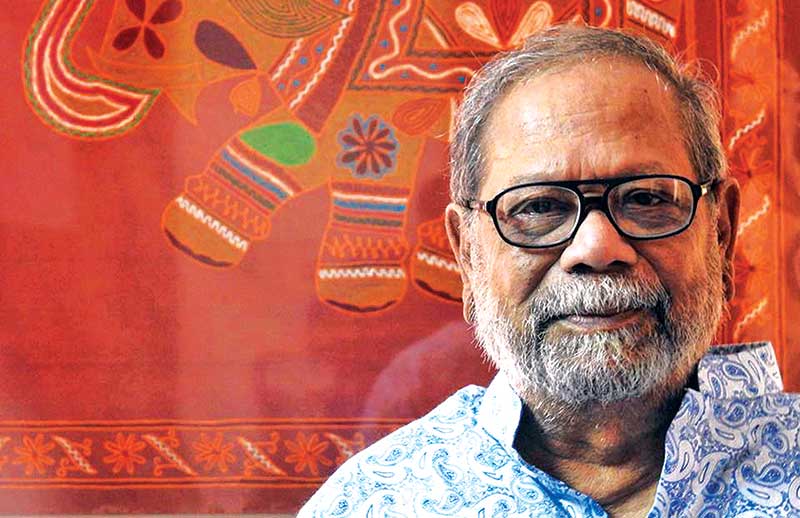
Murtaja Baseer is considered a distinct and unique personality in the art milieu of this country for his lucid thought process, strong and meticulous drawings, balanced use of colours and a strong social commitment. His quest has always motivated him to deliver new themes, styles and techniques in a constant pursuit through tests and trials. With the progress of an illustrious career, Baseer has gradually transformed his working style into abstract realism. He never draws a single line without a logical explanation. Like other contemporary artists of his time or later generations, his position remains at the top.
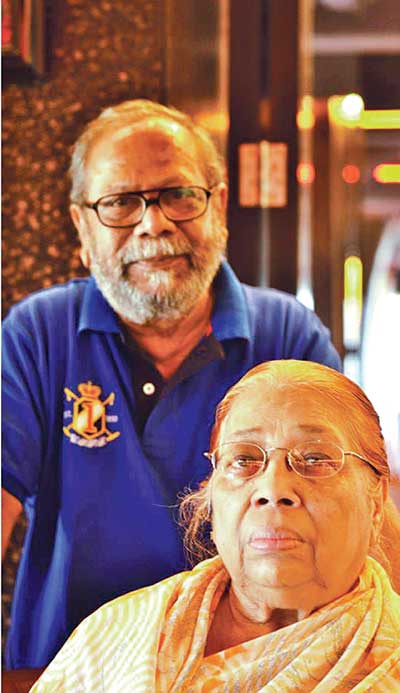
Murtaja Baseer with his late wife Amina Bashir
Drawings are a reflection of personal observations of an artist. It is the fundamental foundation of art. Drawings articulate an artist's expressions and represent his/her personality. Veteran artist Murtaja Baseer is one of the finest drawing exponents in our country and his drawings are an effectual mirror of the character's personality and insight. The simplified lines of his drawings have become his personal hallmark and the artist seemingly invests much time on them, as he does with his paintings. Baseer is an artist who adheres to experimental realism. Mingling romanticism and impressionism, his drawings seemingly document his intense observations of the portrayed characters.
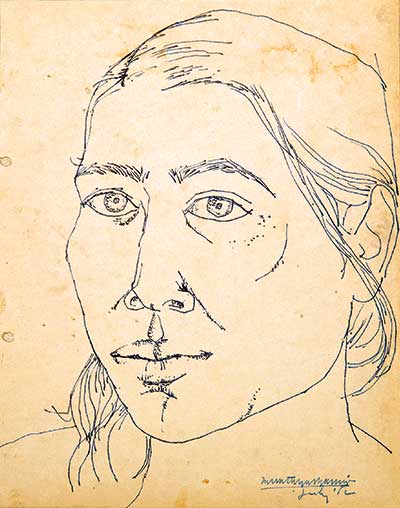
Eminent painter Murtaja Baseer's beloved wife Amina Baseer died on May 13 in 2017. Needless to say that it was extremely shocking for him and he would bear the pain till the last day of his life. The painter has in total done twelve sketches on his wife in different periods in different circumstances. The couple happily married on May 27 in 1962. He first drew his wife on July 17 in the year of his marriage. In the same month, he drew four more portraits and the last one he did on July 28. In the month of December of the same year, the painter was invited from the Pakistan Arts Council in Lahore where his thirty paintings were displayed, these being done with oil, lacquer and enamel paint. Under the title "Paintings: July-October 1962", the exhibition was held from December 10 to December 19. The same exhibition was held in Rawalpindi and it was organised by the Society for Contemporary Arts. During that time, he portrayed his wife on the back flap of the brochure. The drawing was done by ball-pen. After a long pause, the painter drew two drawings in 1974 of his wife and then again he tinted two more drawings in 1975. Among the drawings of his wife, the drawings from 1974 and 1975 are comparatively meticulous, time consuming and very detailed in terms of his use of lines. His lines have a lyrical synchronisation and the painter has a good control over lines. The most significant aspect of his drawing is how a simple line could be produced to give a momentous meaning and impart to the viewers a thoughtful message. His skilled hands always bear his sincerity to surveillance and hold the emotion and sentiment of the character. The drawings have been done solely by ink.
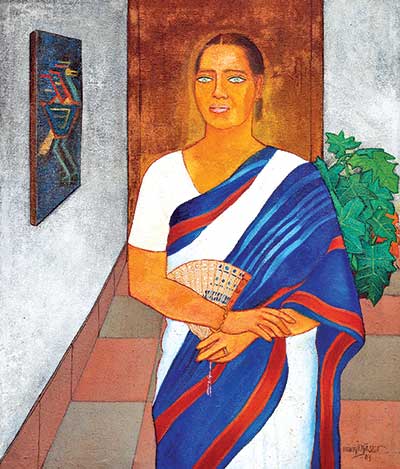
My Lady Oil on canvas 2003 Dhaka
After a lengthy hiatus, Baseer again sketched his beloved wife in 1988 in Calcutta (now Kolkata). The drawing was done on 5th of October. The drawing has been done by ink and here the lovely woman wore glasses and looks quite fair and unique from other portraitures. In this piece Baseer has used some sweet lines and the lines provide us with an intense clarity about the character.
While visiting Kolkata, the painter visited several museums in Delhi, Calcutta, Banaras and 3,000 villages in the nine districts of West Bengal (now Pacchim Bangla) -- under the fellowship of Indian Council for Cultural Relations (ICCR).
For the last time when Baseer drew his dearly loved wife was March 30 this year from a photograph of the lady as she was no more available in person. The painter has never copied from any photograph---this is one of his fortes. He has portrayed it with the medium of lead. March 30 marked the 78th birth anniversary of Amina Baseer.
The drawings denote varied moods of the woman. Baseer likes to portray both emotions and adoration in same frame. Portrays seeming to be in motion and articulation of an untold story are the noticeable aspects of his works. He is mainly a figurative painter and his figures usually capture pensiveness, bliss, understanding of life, experience and passion. Appearing in motion, his subjects have a realistic attachment with lines articulating profound romanticism. The drawings provide us with a deep essence about the meaning of life, affection and quintessence.
Besides those mentioned above, the painter has done an oil painting titled "My Lady" in 2003 based on his wife. The lady wears a white-blue sharee, simple ornament like a small earring and also looks to have blue eyes. She seems to be holding a fan in her hand. She stands in the middle of a room that has tiled floors.
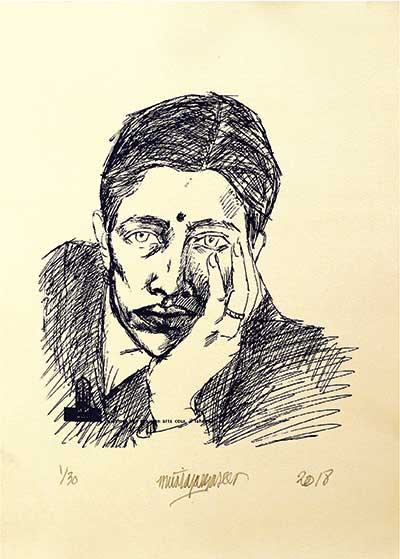
Drawing-4 Pen and Ink on paper 1962 Lahore
Galleri Kaya, one of the leading full-fledged galleries in the country has taken a praiseworthy initiative to make a folio with a set of twelve serigraphs in thirty editions taken from the treasured twelve drawings of Baseer. The galleriest-cum-painter Goutam Chakraborty of Kaya wants to popularise the medium of serigraphy among the artists of different genres and he sincerely seeks to provide the folio of the serigraph to art aficionados in the country. Previously the gallery took a number of worthy initiatives in this regard. Serigraphy is the oldest form of printing. The serigraphs have been done in acid-free off-white and a little bit yellowish shade on Fabriano papers which are made of finely woven polyester.
Serigraphy was introduced to the west in the late 18th century, but it didn't catch on until the early 20th century, when silk mesh became more available and a profitable outlet was discovered. Serigraphy, also known as silk screening, screen printing or serigraph printing, is a stencil-based printing process in which ink is forced through a fine screen onto the paper beneath.
Many are perhaps not familiar with Baseer's other identities as a poet, short story writer, novelist, researcher, numismatist and filmmaker. Baseer has written novels and was acclaimed for his meticulous style and unique choice of themes. In 1954, he wrote a novel, titled "Ultramarine". The novel was based on contemporary life in Kolkata and prevailing social issue of the time. He published a collection of short stories called 'Kanch-er Pakhir Gaan" in 1969. He wrote two more novels - "Mitar Shangey Char Shandha' and "Amitakkhar". He has a collection of selected works, "Murtaja Baseer: Murto O Bimurto".
Drawing-1 Pen and Ink on paper 1962 Dhaka
Reading Baseer's poetry is like an emotional journey. As a poet, he is a modernist in the complete sense. His style is unquestionably unique, expressive and easily comprehensible. When reading his poems, one feels the yearnings of a lonely soul, unbound sorrow, the vacuum in a melancholic heart. Baseer's poems are voyages into fantasy. He has a collection of selected poems, titled "Fresh Blood, Faint Line".
Baseer has also worked as a screenplay writer, art director and chief assistant director for the Bangla film "Nadi O Nari" in 1964, and as an art director for the Urdu film "Kaise Kahoon" in 1965. His work "Mudra O Shilalipir Aloke Banglar Habshi Sultan O Tothkalin Samaj" was published in 2004. Several articles by Baseer have been published in the Journal of the Numismatic Society of India, a prestigious publication.
The painter is still actively exploring the diverse world of art. He has done a series of works articulating contemporary life and issues. His quest has always encouraged him to deliver new thoughts, styles and techniques in a constant pursuit of experimentation.
Published by the Editor on behalf of the Observer Ltd. from Globe Printers, 24/A, New Eskaton Road, Ramna, Dhaka.
Editorial, News and Commercial Offices : Aziz Bhaban (2nd floor), 93, Motijheel C/A, Dhaka-1000. Phone: PABX- 41053001-06; Online: 41053014; Advertisement: 41053012.
E-mail: district@dailyobserverbd.com, news@dailyobserverbd.com, advertisement@dailyobserverbd.com, For Online Edition: mailobserverbd@gmail.com