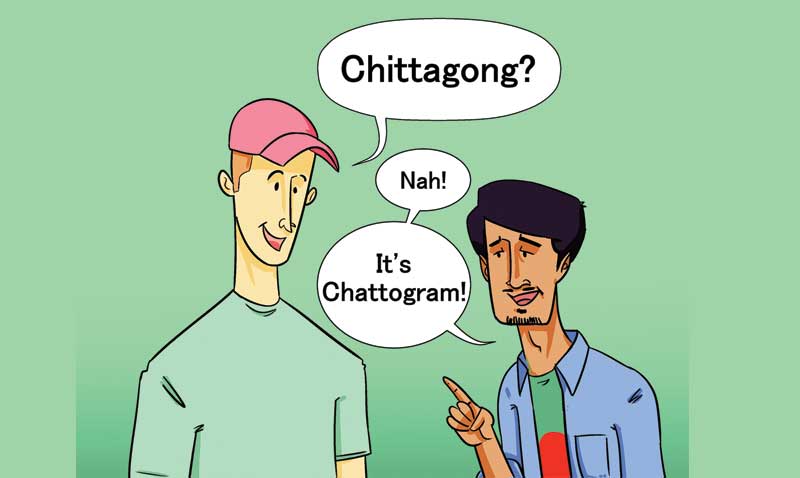
On March 30, 2018, a press release published in a reputed daily of Bangladesh revealed that the government was going to alter the English spellings of the names of five districts. They claimed that the districts are proper nouns and should be spelled in English alphabets in a way that echoed their Bangla diction.
Prime Minister Sheikh Hasina had scheduled her first meeting regarding this at her office with the representatives from the National Implementation Committee for Administrative Reorganisation-Reform (NICAR), on the following Monday, April 2, 2018.
It is to be noted that NICAR deals with district related issues along with ministry formation and keeps track of administrative legislatures for the divisions and districts of Bangladesh, with the prime minister as their convener.
Later, on April 4, 2018, it was confirmed that NICAR has approved the new spellings for five districts, which were spelled previously as Chittagong, Barisal, Comilla, Bogra and Jessore. The names will now be spelled as Chattogram, Barishal, Cumilla, Bogura and Jashore respectively.
A mixed reaction was received from the population regarding this issue. Some said that it is a good initiative. As our identity comes from our struggle for mother language, Bangla, the names should be spelled according to Bangla dictions.
On the other hand, some thought that changing the spellings were unnecessary and this alteration will cost the government a lot of time and resources to complete. Hence, such kind of modification was evitable.
The birthplace of the language English is England, and it came to this subcontinent on the boats of the English around the 1600s as they entered this zone for commerce. Later, the notions of trading transformed into tyranny as they started setting up colonies, which gave them certain powers such as changing anything they didn't like.
It all started when the English ruling class were unable to pronounce Bangla names correctly. So they opted for a spelling that better suited their own diction. Even though it was improper to pronounce Bangla with English diction, the names were recorded in English with spellings that satisfied the British tongues only.
The country emerged as East Pakistan in 1947 and as Bangladesh in 1971, but the colonial flavour still lives through these names and their diction. It seems as if we are still under colonial rule, implying that we believe, deep down, that the British are still superior to us, in terms of even our own language.
This reformation in spelling is a good initiative if it aims at discarding colonial remnants in the post-colonial era. "Spellings of some districts date back to the British period, and they needed to be updated in accordance with their Bangla pronunciation," said N M Ziaul Alam, Secretary of co-ordination and reforms, Cabinet Division, NICAR.
However, one other issue has come to light and cannot be left out of discussion. Changing the names may give priority to the national language of the country Bangla, but it will also cost millions.
The trading industry might also suffer as Mostafiz Uddin, managing director of Denim Expert Ltd and CEO of Bangladesh Apparel Exchange (BAE) said, "Changes such as this take time to get used to. People will get confused when they come across the new spellings as most people are still unaware of such development."
However, Mir Nasir Hossain, former president of the Federation of Bangladesh Chambers of Commerce and Industry (FBCCI) shared his thoughts from a different angle, "Changes like this are not new. If we look at our neighbour India, they have changed the spellings of a number of their cities, such as Mumbai and Kolkata. The confusion will not last for long and everyone will get used to the new spellings over time."
Even though many claim that they spellings are not yet correct in terms of pronunciation, but if the phonetic transcription is taken into consideration, then, according to English Phonology, they, to maximum extent, do sound like the Bangla way of pronouncing the names.
"Raastro Bhasha Bangla Chai!" This demand echoed into my ears as soon as I heard that the spellings of the district names were changed. Different people have different opinions regarding this change, both positive and negative. Nevertheless, the change is already made and if the nation wants to free itself from a long-standing colonial mindset, then this is but the first step.





