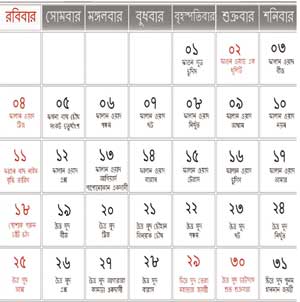
It is a matter of concern whether kids these days know anything about our culture or not. Some who have concerned and responsible parents or teachers might have necessary knowledge on the subject but most of them don't. In this age, technology has brought the western world to our pockets, thus kids seem to lose their connection with their actual roots.
For instance, every kid can name the 12 months of the modern day Gregorian Calendar in one breath. However, only a handful might know the names of the Bengali months. Although besides the importance of knowing the names of Bengali months as Bengalis, these months play a great role in shaping our culture. Many grand festivities that we celebrate nationwide are related to our Bengali months. There are many delicious fruits that we wait for the rest of the year because it grows in a specific Bengali month.
So, let's see the names first of these glorious Bengali months before we dive into the significant traits some of them offer - Baishakh, Jyoishtho, Ashar, Shrabon, Bhadro, Ashshin, Kartik, Ogrohayon, Poush, Magh, Falgun and Choitro.
BaishakhBaishakh - the name of the month is derived from the position of the sun near the star Bishakha. The first day of Baishakh is celebrated as Pahela Baishakh or Bengali New Year's Day. It is one of the most celebrated occasions of our country. The day is observed with several cultural programs, festivals and carnivals all around the country. The day is also the beginning of all business activities in Bangladesh.
AsharhAsharh is the third month of the Bengali calendar. It is the first of the two months that comprise the wet season, locally known as 'Barsha', when the monsoon wind blows. It is named for the constellation Uttarashadha, identified with Sagittarius. It is one of the first five months of the year that have 31 days, according to the Bangladeshi version of the Bengali Calendar.
AgrahayanAgrahayan is the eighth month in the Bengali calendar. It is the second of the two months that make up the Dry season, locally called 'Hemanta'. It is commonly believed that this month is very auspicious for marriage. The month is named after the star Mrigash?ra. The first day of the month is the Nabanna harvest festival.
Nabanna is a Bengali harvest celebration usually celebrated with food, music and dance in Bangladesh. It is a festival of food; many local preparations of Bengali cuisine like pitha are cooked and offered.The festival is celebrated with arranging a mela which is called 'nabanna mela'. It is one of the numerous festivals that gave the name 'baro mase tero parban' (thirteen festivals in twelve months) to the land of Bengal.
PoushPoush is the 9th month of both the Bengali calendar. It overlaps December and January of the Gregorian calendar. It is the first month of the winter season. This month is named after the star Pushya. This month marks the start of winter in the Bengali calendar.
During Poush, crops are harvested and farmers often have ample food and income. Bengali people celebrate Poush Sankranti as one of their festival on the last day of Poush. They make Pitha at their homes and share those among each other. Bangladesh Poush Mela Udjapon Parishad organises a three day fair in Dhaka, Bangladesh.
Speaking of Poush Sangkranti, another annual festival has a connection with this very day - Shakrain Festival. It is also known as Kite Festival and Ghuri Utsob. It is an annual celebration in Dhaka, observed with the flying of kites. It occurs at the end of Poush. This day is known as Poush Sangkranti.
Shakrain Festival in one of the oldest annual festivals of Bangladesh. It is a famous and a very important event in Bangladeshi culture. It is the symbol of unity and friendship in Bangladesh.
FalgunFalgun is the eleventh month in the Bengali calendar. This month is named after the star Uttorfalguni. It marks the arrival of spring, the sixth and final season in Bangladesh. The first of Falgun usually falls on 13 February of the Gregorian Calendar.





