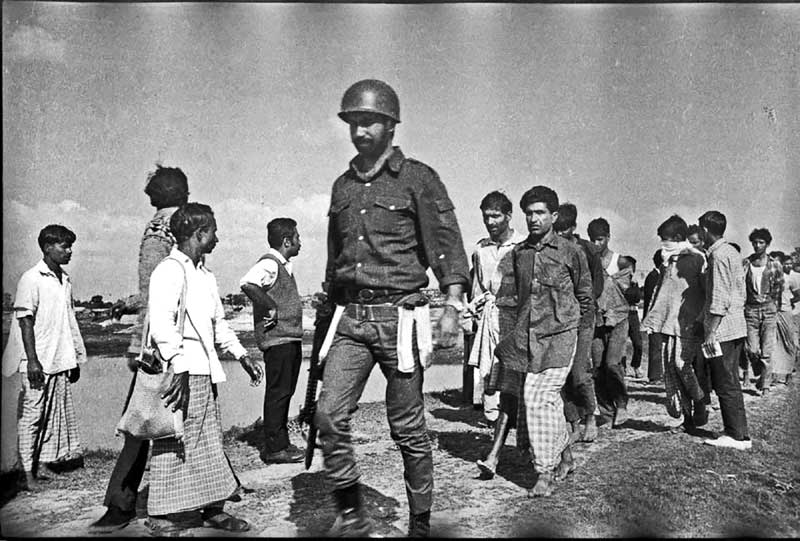
Chief of the Joy Bangla Bahini Kamrul Alam Khan Khasru taking away the collaborators, December 1971
I distinctly remember my introduction to photographer Amanul Haque at his apartment at Aziz Co-operative Housing Society, Shahbagh in the city in 2011. I visited his residence several times and talked long on his life and different aspects of photography, cinema and the historically significant personalities who met him in his chequered lifetime. His studio was spacious and people from every stratum came over to see him and his works. But his photographs and documents were haphazardly crisscrossed over the table, chair and his bed. He couldn't properly remember where he used to keep his documents and essential negatives. He was sometimes hot-tempered but bold and uncompromising in his stance. Amanul was a confirmed bachelor and led a very simple life where had no ambition and urge to show up. He was famous but he unintentionally ignored it. Amanul Haque's camera has captured many remarkable images of the Language Movement and Liberation War. His valorous photographs document our glorious history and the saga of its people -- valuable assets for post-Liberation War generation. These rare photographs help us explore our identity and existence. During national crises, his thought-provoking images help us to see things in perspective. Amanul's unmistakeable talent can also easily be related to his professional relationship with legendary filmmaker Satyajit Ray.
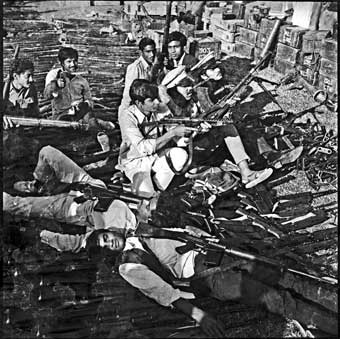
Freedom fighters gather in the Dhaka stadium to surrender arms to Bangabandhu Sheikh Mujibur Rahman, 1972.
Tenacious, courageous and patriotic -- these epithets best describe Amanul. He photographed Language Movement martyr Rafique's distorted face, enraging the authorities. Soon afterwards, the police was after him. After many trials he managed to come out of this dragnet. Lanky, white bearded and outspoken, Amanul used to be very disheartened at the fact that his photographs have often been published in various documents, journals and historical books without credits. Amanul's tryst with the camera began when he was a student of Class VIII, even though cameras were a rarity in those days. As he recalls, "Back then I used to take photographs of sailing boats, fishermen, children wading in a pond -- in general… the panoramic beauty of rural Bengal. As a novice photographer, these themes were very attractive to me and persuaded me to carry on in this direction. Once, I sent my photographs to The Azad, then a recognised Bangla newspaper (first published in 1936 from Calcutta). The first editor of the newspaper was Maulana Mohammad Akram Khan. After Partition, the paper shifted to Dhaka and came out on the stands in 1948. Abul Kalam Shamsuddin was editor at the time. "My photographs were frequently published in The Azad and earned recognition and accolades. I became completely dedicated to photography. My passion, dreams and hopes were immersed in it.
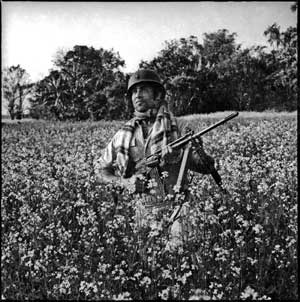
An armed freedom fighter amidst a mustard field in the country
"In 1954, the East Pakistan Literary Conference was held at Bangla Academy. Manoj Basu, Devi Prashad, Subhash Mukhopadhyay and other leading literary figures attended that conference. Fortunately for me, one of my solo exhibitions titled, 'Amar Desh Chitramala,' was being held at the Bangla Academy premises at that time. The exhibition was lauded, and introduced me to the Indian writers. My photo titled, Alosh Modhano,' was published in an issue of 'Notun Shahittyo (edited by Anil Singh),' a literary journal published from Calcutta. The photo featured the plight of a refugee family. The image moved many. I had become completely drawn to Marxism by that time." "In the mid-'50s I moved to Calcutta from Dhaka and met Subhash Mukhopadhyay. Subhashda was very close to Satyajit Ray. He introduced me to Ray and I showed him my photographs. Ray told me that he had seen the images in one of the earlier issues of 'Notun Shahittyo.' This intrigued me and encouraged me to work with him," the photographer reminisces. The low profile and introverted Amanul says, "In my view, Satyajit Ray was a complete human being. To find such a character is rare."
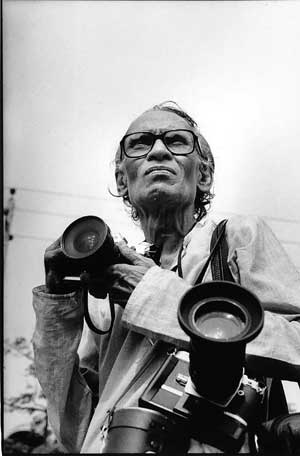
Amanul Haque
Bijoya Ray (wife of Satyajit Ray) was greatly appreciative of Amanul's talent. In her book, "Amader Kotha," she wrote, "A young man named Amanul Haque came to our house in 1959. His good manners won us over. Manik (Satyajit Ray) liked him and allowed Amanul to photograph him. Amanul became very close to us, even though for a short period." In a journal, Satyajit Ray wrote, "I have known Amanul Haque for more than 20 years as a photographer of imagination, skill and enterprise. Over the years, he has kept pace with technical developments and has used them to further his aims as a creative interpreter of actuality. For over a generation, he has virtually recorded every aspect of life in his country, revealing a deep love for Bengali life and culture in all its manifestations. He also has the potential to portray it in film in documentary form, having been a keen student of the cinema and an observer of my working methods in the early sixties." Marie Seton wrote a book on Satyajit Ray titled, "Portrait Of A Director Satyajit Ray." Recalling her meeting with Amanul, she said, "Early in March 1962, and for approximately a year, I saw a considerable amount of Mr. Amanul Haque and his work. I met him with Mr. Satyajit Ray in Calcutta when I went there to stay for the purpose of writing a book on Mr. Ray's work. I am very deeply impressed by the range of his work, his compositions and the way he captures authenticity at a single moment. I think Mr. Haque is a very outstanding photographer. Mr Satyajit Ray has had the utmost admiration for Mr. Haque over a period of many years." Today marks the 5th death anniversary of Amanul Haque.
Published by the Editor on behalf of the Observer Ltd. from Globe Printers, 24/A, New Eskaton Road, Ramna, Dhaka.
Editorial, News and Commercial Offices : Aziz Bhaban (2nd floor), 93, Motijheel C/A, Dhaka-1000. Phone: PABX- 41053001-06; Online: 41053014; Advertisement: 41053012.
E-mail: district@dailyobserverbd.com, news@dailyobserverbd.com, advertisement@dailyobserverbd.com, For Online Edition: mailobserverbd@gmail.com