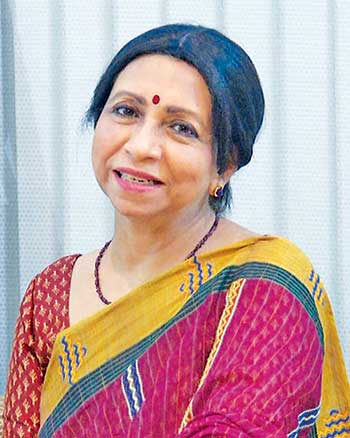
"It was an evening of 25th March. The evening was nothing special for us until a phone call came from my aunt to my father. "Do you know the Independence of Bangladesh has been declared?" My aunt asked over the phone. My father replied, "Really?" And the line was cut off," narrates Dalia Nausheen. Dalia was only 14 then- a curious teen, who was seeing the moon through her father's telescope and kept wondering about astronomy and that Chander Buri. Suddenly she saw a light and thought that it was probably a comet, which was actually a military jeep. Then the phone call came from her aunt. "It cannot be described in words how our feelings were then. I saw the flames and smokes of burning residence, the heart wrenching crying and hauling of so many innocent people. There was horror all over. So, many questions were hitting my mind. What was happening actually? We tried to catch a radio channel but we could not. Some people came to my father with current news updates. These people were very expert and knew how to move in when there was a horrified situation going on," tells Dalia. Dalia's father is the famous Muzharul Islam who is considered as an architect guru of Bangladesh and a grand master of regional modern architecture in South Asia. He was also involved in politics. Dalia and her siblings used to see their parents in political environment from a very early age. So, the political and cultural activities were in their veins. Dalia recalls again, "Continuously the trucks were moving. I could not resist seeing what was going outside. From the gap of curtains, I saw some tall men and trucks. Those trucks were occupied with some dead and alive men. Just before the sunrise, I saw some jeeps with military army and some young men whose hands were tied. The military had shot all of them. The curfew was suspended for an hour. My father told us to leave the house. He said that we will be going to Wari to my aunt's house. We did not care for any belongings, we just left. My elder brother was missing then. My mother understood that he had gone to free the nation." When Dalia and her family reached her aunt's home, they observed a different scenario. Many Hindu women were given shelter. They were there as a mass slaughter happened in the Hindu-majority area. Her aunt said it would not be safe for them to stay there. It is better to return their home. So, they returned to their home. On March 27 in 1971, the curfew was again suspended for two hours. They decided to go Korotia, Tangail. The journey was not pleasant for them. They had to encounter dead bodies and chase from the Biharis. "We stayed with a family, where we were 15 girls. The family was very generous. They loved us and gave us shelter. We had to live on puffed rice but that seemed good. We could not sleep for a single night. There was a fear haunting us every single moment. But the village people were big-hearted. They told us whatever you need, you can take. One day, at 5am the armies attacked but we got the information beforehand. We all started running, running until we fell down. We were living our life in that way. Once, we met a freedom fighter who was very lean and thin. He might not have any powerful weapon but he had the courage to fight and sacrifice his life. That gave us motivation that courage is so powerful. And we got a faith that we will conquer, we will achieve a beautiful flag and a new nation in the world map," narrates Dalia. Later, Dalia had to come to Dhaka for a few days. Now they had to go to India. The journey was very remarkable. From a village of Comilla they had to go 22 miles by rickshaw. And the road was made by young children in the side of the paddy field. Even the rickshaw pullers were so courageous. 22 miles was not a little distance. "We stayed at a refugee camp at an Art College in Agartala. There were so many refugees! After staying there for two days, we went to Kolkata. One of my uncles, Komol Siddique gave me an address 144, Dhormotola Street, Lenin Shoroni and told me to come the next day. We meet Sanjida apa and we made a group named "Mukti Sangrami Shilpi Shongstha". We sang many patriotic songs and let the Indians know why our Liberation War was necessary. Some prominent songs were 'Banglar Mati Banglar Jol', 'Janatar Shangram' etc. One day, we were invited to a place; there was a Harmonium and a microphone. Later we got to know that is the studio is for Swadin Bangla Betar Kendra. On the very first day we sang 7 songs. But later after we sang 15 songs, those songs were in chorus. We did not have sufficient instrument but our songs worked like weapons. We sang like the way a fighter triggers a gun. We poured our hearts out in the melody. After the Independence, our bond became very strong. We had become a true family."
Published by the Editor on behalf of the Observer Ltd. from Globe Printers, 24/A, New Eskaton Road, Ramna, Dhaka.
Editorial, News and Commercial Offices : Aziz Bhaban (2nd floor), 93, Motijheel C/A, Dhaka-1000. Phone: PABX- 41053001-06; Online: 41053014; Advertisement: 41053012.
E-mail: district@dailyobserverbd.com, news@dailyobserverbd.com, advertisement@dailyobserverbd.com, For Online Edition: mailobserverbd@gmail.com