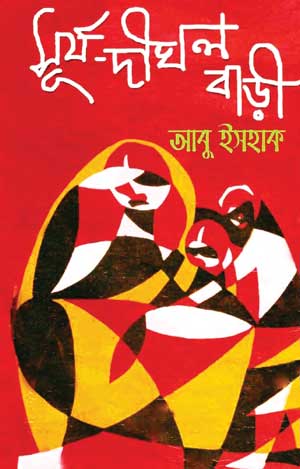
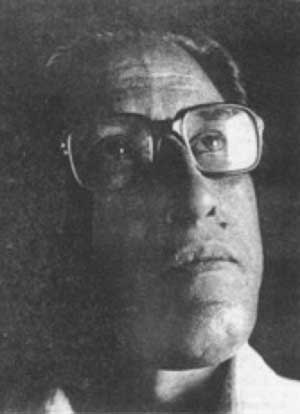
For his seminal work Surjo Dighal Bari, Abu Ishaque shot into fame in his early age and became one of the prominent figures of Bangla literature. His literary career spanned more than four decades, and his creative endeavour and genius produced many fictional and non-fictional works.
Abu Ishaque was born in the village Shirangol of Naria Upazila in Shariatpur District on 1 November, 1926. He passed his matriculation from Taraprasnya English School in 1942. Two years earlier while he was an eighth grade student, he wrote his first story "Abhishap". The story was published in famous Nabajug magazine edited by the poet Kazi Nazrul Islam. He received his higher secondary education from Faridpur Rajendra College and moved to Karachi to enrol in Karachi University.
Before his graduation from Karachi University in 1960, he rose to prominence by publishing his novel Surjo Dighal Bari. Naobahar, a Bengali monthly magazine edited by poet Ghulam Mustafa, published this novel in instalments. Catching the attention of the readers and critics, the book turned an instant hit in both East and West Bengal.
The background of the novel was World War II, famine, communal riot and the partition of India. Both these and the stylistic language of the novelist appealed readers from all walks of life. The plot spins about the story of Jaigun and her struggle to live with her two children. The protagonist (Jaigun), a famine-affected widow, moves to the city, failing to cope up with the village life. But, the harrowing experience of city life -- with its myriads of plights and bitter experience -- forced Jaigun to go back to her village. Here, she faces existential crisis -- now coming from the village bigots with their superstitious outlook towards the world. Torn between city and village life, Jaigun's pang shows the crisis of modern time. The novel also criticizes the dystopian reality -- for Pakistan emerged into its existence with a promise to secure the lives of its citizens yet it utterly failed to do so as the struggle of subaltern class intensified since its very inception.
The book was hailed by the critics for its impressive plot and themes. It was published a number of times from different publishing houses. In 1979, the book was made into a film directed by Moshiuddin Shaker and late Shaikh Neamat Ali. It won a number of local and international prizes. Several years later, the book was also translated into Czech and Urdu languages.
Abu Ishaque wrote two more novels Padmar Polydeep and Jaal. In Padmar Polydeep, he depicted the struggle of subaltern class in the holms of the river Padma. The clash between unscrupulous local leaders and working class people is its plot. However, in his third novel, Jaal, he spun a detective plot based on his own experiences in Pakistan and Bangladeshi intelligence. The book was published in 1988. His collections of short stories, Mahapatanga and Harem, were published in 1962 and 1963 respectively. Some stories were taken from these collections to be included in the syllabuses of secondary and higher secondary education. His drama Joyoddhoni was published in 2001.
In his mid-career, he decided to write two dictionaries: in Bangla and English. Dr Muhammad Shahidullah, the most famous linguist in our country encouraged him to embark on this uphill task. He included synonyms and antonyms of each word in these dictionaries. Unfortunately, he could not finish these works though Bangla Academy has published them partially.
For his literary excellence, Abu Ishaque was awarded Bangla Academy Award in 1963, Sundarban Shaihtya Puroshkar in 1981, Ekushey Padak in 1997, and Independence Award in 2004. On 16 February, 2003 he breathed his last in Dhaka.





