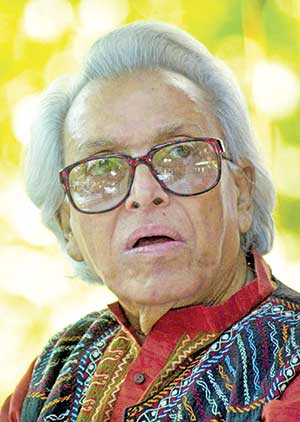
Shamsur Rahman was a torchbearer in modern Bangla literature of the post-Tagorean era. The plights and pangs of modern life and urban alienation were his lifelong themes and areas of experimentation. A lonely Sherpa (mountain-climber) -- as Humayun Azad would fondly called him for his poetic style and humble manner -- he devoted his entire life in making a literary career that spanned almost half a century.
Born on 23 October, 1929 in Mahut Tuli, Dhaka, Shamsur Rahman was a poet, columnist and journalist. However, his genius radiated mostly in poetry. Major themes of his poetry and writings include liberal humanism, human relations, romantic rebellion of the youth, the emergence and consequent events in Bangladesh, and opposition to religious fundamentalism. For his undying devotion to create a distinguished stream of Bangla poems and understanding our psyche best, some regard him as the unofficial poet laureate of Bangladesh.
He was the fourth of thirteen children of his parents. He studied at Pogos High School from where he passed matriculation in 1945. In his leisure, after the matriculation, he read Rabindranath Tagore's Golpo Guccho. He told that this book took him into the extra ordinary world and transformed him into an altogether different personality.
Later, he took his IA as a student of Dhaka College. It was the time when his poem Unissho Unoponchash was published in Sonar Bangla, which was then edited by Nalinikishor Guho. He studied English Literature at University of Dhaka for three years but did not take the examination. After a break of three years, he enrolled to BA pass course and received his BA in 1953. He also received his MA in the same subject in the following year.
Shamsur Rahman's first book of poetry, Prothom Gaan Dwityo Mrittyur Agey was published in 1960. Political turbulence of '60s and '70s was reflected in his poems which he witnessed himself. He wrote his famous poem "Asad-er Shirt" as a tribute to the mass uprising of 1969. During the Liberation war, he wrote a number of poems which brilliantly articulated the aspiration of a nation fighting for its existence. Later, these poems were published in Bondi Shibir Thekey (1972). He continued writing poems in the post-war Bangladesh and remained as the poet whose words reflected the history of the nation. During the '90s Gano Abbhutthyan (Mass Upsurge), he published Buk Taar Bangladesher Hridoy -- it indicated the great sacrifice of Shaheed Nur Hossain.
Shamsur Rahman wrote most of his poems in free verse, often with the rhythm style known as Poyaar or Aakhsharbritto. It is popularly known that he followed this pattern from poet Jibanananda Das. He also wrote poems in two other major patterns of Bangla rhythmic style, namely, Matrabritto and Shorobritto. In such mediums, he painted the sorrows and happiness of urban life. Nostalgia, loneliness, boredom and pangs all are artistically and philosophically rendered in his poems. He was also brilliant in prose. His 'Sritir Sohor' or 'The City of Memories' is a wonderful account of his boyhood in Dhaka. Lucid and poetic, his prose instantaneously takes the reader into a magical past.
Shamsur Rahman's poetry transcends the limits of place; moreover, they soak the language of our time. Though he penned middle-class experiences in his poetry mostly, for his broad and catholic perspective his poems transcend class, race and religion. He has soared to an unparalleled rung in Bangla literature. He never stopped his pen even after the attack on him by a fundamentalist militant group, Harkat-ul-Jihad-al-Islami in 1999. The lonely Sherpa breathed his last on 17 August 2017.
Poetry
Prothom Gan Ditio Mrittur Age (1960)
Roudro Korotite (1963)
Biddhosto Nilima (1967)
Niralokay Dibboroth (1968)
Neej Bashbhumay (1970)
Bondi Shibir Theke (1972)
Tableay Applegulo Heshe Othay (1986)
Shopnera Dukray Othay Barbar (1987)
Khub Beshi Valo Thakte Nei (1987)
Moncher Majhkhanay (1988)
Buk Tar Bangladesher Hridoy (1988)
Hridoy Amar Prithibir Alo (1989)
Shay Ak Porobashay(1990)
Grihojudder Agae(1990)
Khondito Gourob(1992)
Dhongsher Kinare Bashay(1992)
Shopno O Dushshopnay Bachay Achi(1999)
Krishnopokkhay Purnimar Dikay(2004)
Gorostanay Kokiler Korun Aaobhan(2005)
Andhokar Theke Aloy(2006)
Na Bastob Na Dushshopno(2006)
Novels
Octopas(1983)
Adbhut Adhar Ak(1985)
Niyoto Montaz(1985)
Elo Je Abelay(1994)
Autobiography
Kaaler Dhuloy Lekha
Smritir Shohor





