



| HEADLINE |

|
Unrealistic budget in critical times: CPD
It slams lack of steps to curb inflation, allowing black money whitening with only 15pc tax
Published : Saturday, 8 June, 2024 at 12:00 AM
Business Correspondent


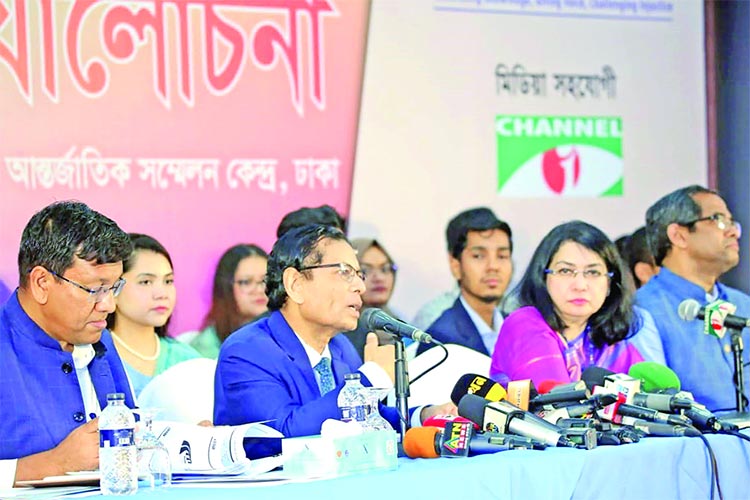 The Center for Policy Dialogue (CPD), a private research organization, has criticized the proposed 2024-25 fiscal year budget, deeming it unrealistic given the current macroeconomic conditions.
 During a budget review meeting at the Bangabandhu International Conference Center on Friday, the CPDs Executive Director Fahmida Khatun highlighted the insufficiency of measures aimed at tackling ongoing economic challenges.
Fahmida emphasized that the steps outlined in the budget to curb inflation and provide relief to low-income people are inadequate. She pointed out that the targets for inflation control, GDP growth, and investment are overly ambitious and unlikely to be met.
The budget, she said, fails to address the economic difficulties effectively, making it an ordinary proposal for extraordinary times.
CPD fellow Mustafizur Rahman echoed these sentiments, criticizing the disparity in tax treatment between legal and illegal earnings.
He noted the unfairness in asking taxpayers to pay a 30 per cent tax on legal income while only 15 per cent is levied on illegal earnings. Rahman called for stricter laws with penalties for illegal income, including additional taxes.
The proposed budget allows black money to be legalized by depositing it in a bank or investing it anywhere, including the stock market, after paying a 15 per cent tax without scrutiny.
This provision, according to Rahman, discourages regular taxpayers and fails to significantly boost revenue collection. The CPD argues that this approach incentivizes those with black money while undermining the integrity of the tax system.
Describing the budget as "devoid of reality," Fahmida reiterated that it would be impossible to tackle the ongoing economic crisis with the Tk7.97 lakh crore proposed for FY25. She listed various macroeconomic challenges, such as high inflation, low foreign exchange reserves, weak currency, reduced imports, and issues in power and fuel supply, all of which the budget fails to adequately address.
She stressed the need for initiatives to reduce inflationary pressure and boost social security programmes to bring relief to the poor. She noted that people are cutting down on living expenses and food habits, which cannot be resolved solely through the central banks monetary policy. A supportive fiscal policy is also required, yet the proposed budget lacks clarity on such steps.
Regarding the facility proposed for the legalization of black money, Fahmida Khatun criticized the provision of whitening black money by paying only a 15 per cent tax without any scrutiny. This practice, she argued, is discouraging for regular taxpayers and does not significantly increase revenue collection. Instead, it incentivizes those with black money and dissuades compliance among regular taxpayers.
Rahman highlighted that the new provision exempts the income from scrutiny even by the Anti-Corruption Commission. This contrasts with the current Income Tax Act, where taxpayers can legalize black money by paying up to 25 per cent tax plus a 10 per cent penalty, risking scrutiny by government agencies.
Further criticizing the budget, Fahmida deemed the inflation reduction target of 6.75 per cent and the export growth target of 8 per cent as unrealistic. With inflation above 9 per cent in May and this years export growth only at 2 per cent, achieving these targets without specific steps is improbable.
The budget also lacks measures to increase investment, which is crucial to rein in inflation. Fahmida noted that the total gross investment target for FY24 was set at 31 per cent, later revised to 23.5 per cent, and this fiscals target is 27.3 per cent without clear steps to achieve it.
In a question-answer session, Rahman highlighted that the budget lacks measures to provide relief from inflation. He pointed out that inflation in goods consumed by low-income people has exceeded 20 per cent, and the budget does not propose any relief measures for them.
Despite Finance Minister Abul Hassan Mahmood Ali unveiling the largest-ever budget for Bangladesh, with a theme of building a "happy, prosperous, developed, and smart Bangladesh," CPDs analysis suggests that the proposed budget is insufficient to restore the countrys economy to its previous state.
Loading...
Loading...
Also read


Editor : Iqbal Sobhan Chowdhury
Published by the Editor on behalf of the Observer Ltd. from Globe Printers, 24/A, New Eskaton Road, Ramna, Dhaka.
Editorial, News and Commercial Offices : Aziz Bhaban (2nd floor), 93, Motijheel C/A, Dhaka-1000.
Phone: PABX- 41053001-06; Advertisement: 41053012; 01793317829, 01550707291, E-mail: [email protected], [email protected] Online: email: [email protected] 41053014; 01550707297 Advertisement: 01550707296
Published by the Editor on behalf of the Observer Ltd. from Globe Printers, 24/A, New Eskaton Road, Ramna, Dhaka.
Editorial, News and Commercial Offices : Aziz Bhaban (2nd floor), 93, Motijheel C/A, Dhaka-1000.
Phone: PABX- 41053001-06; Advertisement: 41053012; 01793317829, 01550707291, E-mail: [email protected], [email protected] Online: email: [email protected] 41053014; 01550707297 Advertisement: 01550707296


