



| HEADLINE |

|
Huge impact of climate change feared on our economy
Published : Monday, 13 May, 2024 at 12:00 AM
Dr Rajib Chakraborty


 Climate change has become a global issue because of its increasing impact on the ecosystem and afterward on human lives. Humans are influencing the climate system, and it is broadly recognized that climate change is a major issue with physical, economic, and social risks that have an immediate impact on the environment.
 In another way, climate change is the result of global warming that is partly due to the greenhouse gas emissions resulting from human activities. In the long run impact of climate change on businesses, some specific economic sectors such as agriculture, tourism, fishing, insurance, and forestry are under serious threat, and the dependency of firms outputs on the natural environment hampers the growth of those businesses.
Thus, the business entities emitting greenhouse gases, face stiff competition from their rivalry due to the increased operating costs, reduced demand, loss of goodwill, image, and legal costs.
After the United Nations Framework Convention on Climate Change (UNFCCC) was established in 1992, the internationally acclaimed Kyoto Protocol (2005), is perhaps the main driver behind the development and adoption of climate change mitigation policies. It sets emission reduction targets by adding carbon taxes putting a price on carbon emissions and has brought necessary modifications in corporate business approaches towards carbon emission.
According to the United Nations Development Programme (UNDP) (2004) as a riverine country, Bangladesh is one of the countries most affected by climate change which has already brought significant changes in the livelihood of the coastal areas. Erratic floods, cyclones, and droughts are affecting the agricultural output of the country at regular intervals and finally, Bangladesh has already started to feel the negative repercussions of climate change.
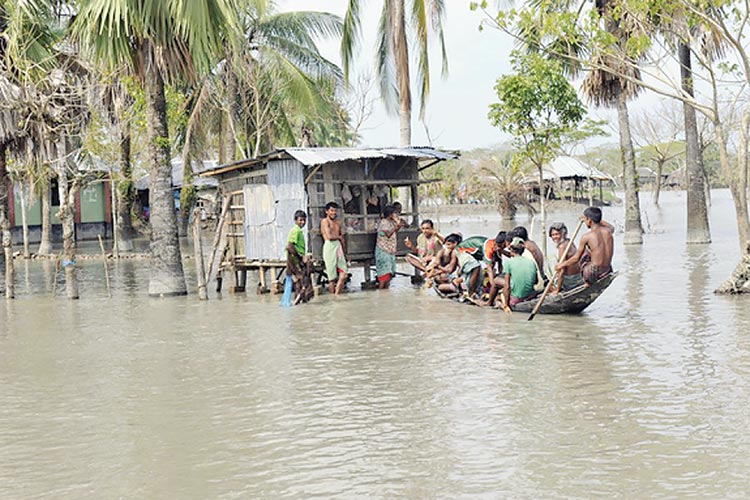
Bangladesh, the country most affected by climate change, is also dealing with enormous difficulties in several social and economic issues, including poverty, health, and economic development in general. Due to the negative effect of the environment on climate, the production of food grain has already been reduced, a large section of people has already been displaced from their homes, and poor governance mechanisms to look after the environmental activities have worsened the situation which also increases the business loss and increases the risk of doing business.
According to the Intergovernmental Panel on Climate Change Assessment (IPCC, 2007), the production of rice and wheat may drop by 32% and 8%, respectively, by 2050. The report also reiterated that the climate change effect will create a scarcity of water for 25% of the population by 2050. The negative effect of climate change and sea level rise with a projected loss of 2-6% in annual GDP may be the reason for displacing 1-2 million people in the southern region of the country.
Bangladesh, which contributed very little to global GHG emissions two decades ago, has been deemed the worlds most vulnerable nation to tropical cyclones. Over the past three decades, an economy that was formerly primarily agricultural-based has changed to one that is industry- and service-led as a result of the rapid economic expansion, with an annual per capita income increase of 4.0 percent. The World Banks Bangladesh Country Climate and Development Report (2022) states that Bangladeshs contribution to global greenhouse gas (GHG) emissions is minimal, making up an estimated 0.4% of the total in 2018.
GHG emissions increased from 115 million metric tonnes of carbon dioxide equivalent (MtCO2e) in 1990 to 221 MtCO2e in 2018, driven by rapid urbanization and a dependence on fossil fuels. Due to the increase in sea level within the last two decades, part of the country would lose 25-35% of agricultural output this century. United Nations (2022) in its report said that Climate change is likely to hamper Bangladeshs economy severely and halt its growth. According to the Germanwatchs 2021 Global Climate Risk Index (CRI), as the 7th most vulnerable country to climate devastation, Bangladesh suffered economic losses worth $ 3.72 billion and 185 extreme weather events due to climate change from the period of 2000 to 2019.
To address such climate change issues, as an active signatory of the United Nations Framework Convention on Climate Change (UNFCCC), the Bangladesh government has established a National Climate Change Fund and has been advocating on behalf of vulnerable developing countries to create funds and release them earlier. However, the good news is that all countries agreed at the 27th Conference of Parties (COP27) of the United Nations Framework Convention on Climate Change to create a fund to address the losses and damage from human-induced climate change.
Besides these, Bangladesh has good achievements in terms of preparedness for planning and action at the national level. On the mitigation and adaptation front, Nationally Determined Contributions (NDC), National Adaptation Plan (NAP), and Mujib Climate Prosperity Plan (MCPP) all have good and pragmatic ideas and proposed activities to face the climate change issues in Bangladesh. To meet SDG targets and become an upper middle-income country, Bangladesh has to implement the already prepared policy framework to minimize the economic and social loss from natural disasters as well as from human-induced climate change.
The writer is a researcher & columnist
Loading...
Loading...
Also read





Editor : Iqbal Sobhan Chowdhury
Published by the Editor on behalf of the Observer Ltd. from Globe Printers, 24/A, New Eskaton Road, Ramna, Dhaka.
Editorial, News and Commercial Offices : Aziz Bhaban (2nd floor), 93, Motijheel C/A, Dhaka-1000.
Phone: PABX- 41053001-06; Advertisement: 41053012; 01793317829, 01550707291, E-mail: [email protected], [email protected] Online: email: [email protected] 41053014; 01550707297 Advertisement: 01550707296
Published by the Editor on behalf of the Observer Ltd. from Globe Printers, 24/A, New Eskaton Road, Ramna, Dhaka.
Editorial, News and Commercial Offices : Aziz Bhaban (2nd floor), 93, Motijheel C/A, Dhaka-1000.
Phone: PABX- 41053001-06; Advertisement: 41053012; 01793317829, 01550707291, E-mail: [email protected], [email protected] Online: email: [email protected] 41053014; 01550707297 Advertisement: 01550707296


