



| HEADLINE |

|
Legal concerns in using AI
Published : Monday, 14 August, 2023 at 12:00 AM
Atia Aman Azizee


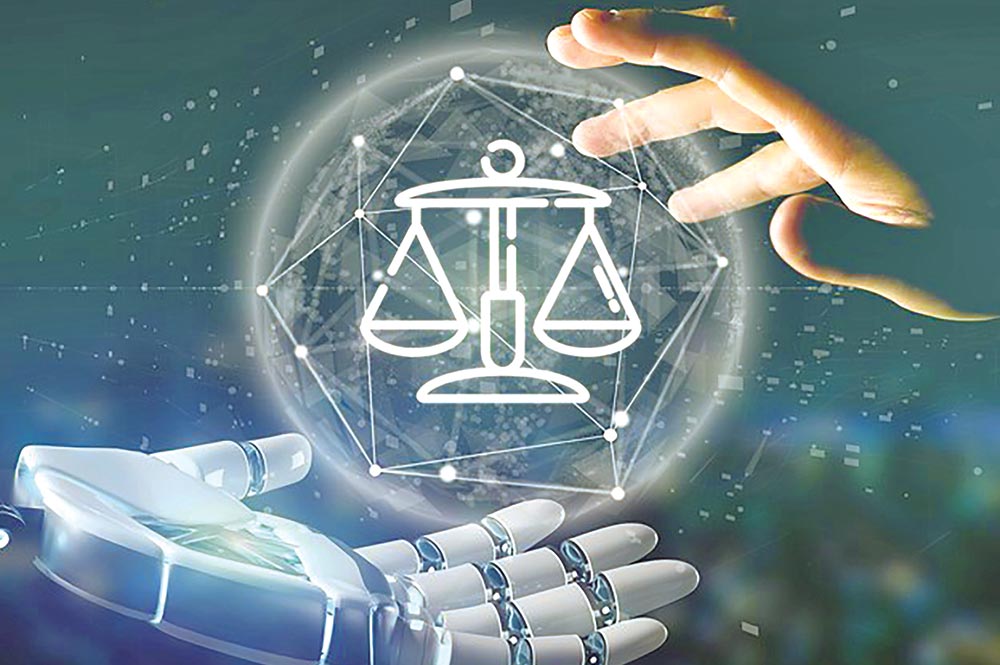 From the deployment of AI operated drones in Russia-Ukraine war, to the interaction of my two and a half years old boy with Google Assistant for having Old McDonald played on android devices, the presence of AI in modern world has become so prominent that seeing AIs presenting news on television also did not come as a surprise to many.
However, with increased use of AI, many legal concerns have also arisen.
Microsoft, GitHub, and OpenAI are already being sued for violation of copyright for using public code in training code-generating AI systems to reproducelicenced code snippets. However, as intellectual property attorney, Eliana Torres, rightly pointed out, the party responsible for compiling the images used for training those AI systems carries greater liability than those companies. This triggers the question, how to legally hold the right party liable for paying damages?
When a Computer malfunctions and causes damages, we hold the manufacturer liable under product liability. When a driver gets into an accident, we hold him liable for committing a tort (i.e. breaching another's civil rights) and/orsue his employer under vicarious liability. However, what happens when an AI operated automated vehicle crashes on pedestrians? Should manufacturer be sued? Or the AI?Or, the one that released it in the air?
Unfortunately an AI is not capable of committing a Tort as even thoughit may have the capacity to gather information to take certain pre-demined steps, it does not have the features required to form an intent to commit an offence. Therefore, claiming compensation from the AI itself is out of question.
Going after the one that released the AI operated drone under vicarious liability is also not an option. This is because, for vicarious liability claims, one must prove that the person, working under the control of the accused, had committed a Tortious Offence in the course of his employment. Since it is not possible to hold the AI liable under Tort, suing its employer under vicarious liability principle automatically gets ruled out.
The manufacturer may also not easily be sued as it is not as simple as selling a computer that malfunctions and ends up causing damages. AIs are capable of developing new skills by themselves, e.g. Google Bard learning Bengali all alone! Hence, it is possiblethat manufacturer indeed could not foresee at all the kind of damage his AI would cause in future.
For this same reason of AIs' unpredictability, imposing individual criminal liability is likely to be even harder than a civil claim for compensation under Tort or Product Liability.
The Copyright suits are also unlikely to result in anything fruitful due to fair trade defencec as was in Google v. Oracle case.
Under such circumstances, the only way of making a claim for compensation is by establishing a link between the act of the AI and a breach of a duty of care on part of a human. Formation of certain regulations can help clarify who owes which part of the duty of care so that liabilities can be clearly determined.
The U.S.A, for example, hasalready developed new policies for "driverless" vehicles that helps determine which autonomous vehicles can be on the street and exactly what level of human supervision it requires. Therefore, when a restricted autonomous vehicle is found on the streets, the one responsible for bring it out without authority going to pay damages any loss caused by it.
European Union membershave also adopted a common regulation with regards to autonomous vehicles. As per the regulation, installation of a "black box" is mandatory for such vehiclesas it may help retrieve relevant information more accurately to detect the real cause of accidents (if any) and assist in forming a more sound expert reportin identifying a possible breach of duty of care.
The regulation also requires the adaptation of an automated lane keeping system (ALKS).The means, even though it is about an automated vehicle, the driver will always remain seated and there has to be a clear physical separation of roads between those accessible by pedestrians or cyclists, and those which are not.
In absence of such clear regulations, it will be difficult to hold humans liable for AIs' actions. Since, an AI dominated future is inevitable now that countries like Hong Kong and UK has already delegated director's duties to an AI system (named Vital) with membership at the board and voting rights, it is time we become well prepared for it.
The writer is Barrister and Advocate, currently working as a legal researcher at A.S & Associates
Loading...
Loading...
Also read



Editor : Iqbal Sobhan Chowdhury
Published by the Editor on behalf of the Observer Ltd. from Globe Printers, 24/A, New Eskaton Road, Ramna, Dhaka.
Editorial, News and Commercial Offices : Aziz Bhaban (2nd floor), 93, Motijheel C/A, Dhaka-1000.
Phone: PABX- 41053001-06; Advertisement: 41053012; 01793317829, 01550707291, E-mail: [email protected], [email protected] Online: email: [email protected] 41053014; 01550707297 Advertisement: 01550707296
Published by the Editor on behalf of the Observer Ltd. from Globe Printers, 24/A, New Eskaton Road, Ramna, Dhaka.
Editorial, News and Commercial Offices : Aziz Bhaban (2nd floor), 93, Motijheel C/A, Dhaka-1000.
Phone: PABX- 41053001-06; Advertisement: 41053012; 01793317829, 01550707291, E-mail: [email protected], [email protected] Online: email: [email protected] 41053014; 01550707297 Advertisement: 01550707296


