



| HEADLINE |

|
Adequate budgetary allocation for WASH demanded
Published : Wednesday, 24 May, 2023 at 12:00 AM
Business Correspondent


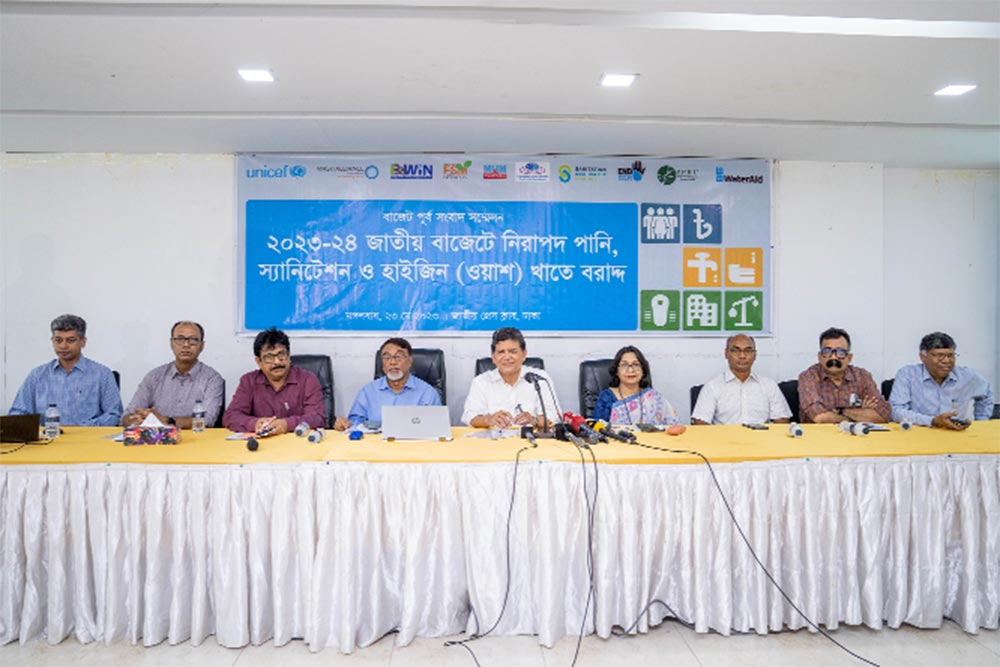 At a joint press conference held by WaterAid, PPRC, UNICEF, FANSA, BAWIN, FSM Network, Sanitation and Water for All, and End Water Poverty, WASH Alliance International and MHM Platform, speakers shared the need for allocation of funds for Water, Sanitation, and Hygiene (WASH) focusing on spatial inequalities in the upcoming national budget for the fiscal year 2023-24.
The press conference was held at the National Press Club on Tuesday.
Eminent economist and Chairman PPRC - Dr. Hossain Zillur Rahman at his keynote speech on behalf of WASH sector stakeholders highlighted, "spatial inequality and community engagement should get priority in ADP Allocation in the WASH sector for the upcoming fiscal year. He stressed focusing two key dimensions - the underserved areas, including chars, climate vulnerable areas, haors, and hilly regions, and the intra-urban inequities.
Emphasizing on the importance of allocating funds for Fecal Sludge Management (FSM) in secondary towns and urbanized villages, is key with adopting a multi-agency policy approach to achieve the national targets of 100% Safe Drinking Water and 100% Safely Managed Sanitation - which is a SDG goals attainment mandate."
Key Findings from the WASH Budget Analysis Study done by PPRC supported by WaterAid, indicated a long-term trend in WASH ADP allocation, with an upward trend but this proportionate increase over the preceding fiscal year is lower (5.44%) than the corresponding rate of increase in the overall ADP size (7.4%). Key findings of the HIES 2022 showed that 92.32% of population have access to improved toilet facilities and prevailing open defecation remains at only 0.69%. DPHE's projects on WASH, DRR and Fecal Sludge and Waste Management (FSWM) to build resilience through disaster risk communication and community engagement process were commended thoroughly.
The press conference highlighted the persisting issue of intra-urban inequities in WASH allocation and proposed a more rational and equitable distribution of funds in the 2023-2024 ADP allocations.
Ms. Hasin Jahan, Country Director of WaterAid, said, "Although the allocation to the WASH sector has increased in the proposed budget over the past few years, it is inconsiderable compared to the need.
In continuation of this, it is the need of the hour to increase the allocation of WASH for the people living in Haor, hilly, coastal, and char areas as the impacts of climate change have made the difficult task even more challenging to achieve the SDG targets regarding water and improved sanitation.
Concluding the press conference, the WASH sector networks jointly put forward the 5 recommendations for the FY2023-24 ADP Allocation for WASH sector.
The recommendations include better attention to hard-to-reach area, adequate allocations and reduction disparity in allocations in urban and remote areas.
Loading...
Loading...
Also read



Editor : Iqbal Sobhan Chowdhury
Published by the Editor on behalf of the Observer Ltd. from Globe Printers, 24/A, New Eskaton Road, Ramna, Dhaka.
Editorial, News and Commercial Offices : Aziz Bhaban (2nd floor), 93, Motijheel C/A, Dhaka-1000.
Phone: PABX- 41053001-06; Advertisement: 41053012; 01793317829, 01550707291, E-mail: [email protected], [email protected] Online: email: [email protected] 41053014; 01550707297 Advertisement: 01550707296
Published by the Editor on behalf of the Observer Ltd. from Globe Printers, 24/A, New Eskaton Road, Ramna, Dhaka.
Editorial, News and Commercial Offices : Aziz Bhaban (2nd floor), 93, Motijheel C/A, Dhaka-1000.
Phone: PABX- 41053001-06; Advertisement: 41053012; 01793317829, 01550707291, E-mail: [email protected], [email protected] Online: email: [email protected] 41053014; 01550707297 Advertisement: 01550707296


