



| HEADLINE |

|
A sustainable solution for Bangladesh’s construction industry
Published : Thursday, 27 April, 2023 at 12:00 AM
Aditya Chowdhury


 To maximize economic and environmental benefits, it is now commonly acknowledged that there is a significant potential for reclaiming and recycling demolished material for use in value-added applications. Environmental effects from construction and demolition (C & D) trash are becoming a significant problem in urban waste management while Bangladesh is experiencing rapid urbanization.
 The 3Rs (Reduce, Reuse, and Recycle) concept embodies the idea of using the fewest resources possible in the production, distribution, and use of items used by society while maximizing reuse, recycling, and recovery. The 3Rs principle has recently begun to receive more attention because of the depletion of natural resources and the rise in environmental contamination. To accomplish this aim, the Bangladeshi government created the National 3R Waste Management Strategy in 2010.
An apartment building under construction generates packaging and debris trash. All four of the most important waste streams (excavated soil, concrete, reinforced concrete, and masonry) are produced at the same time. Concrete, the most popular building material in the world, constructs a lot of waste during construction and demolition. The demolished concrete can be reused to cut waste and carbon emissions and protect natural resources. Utilizing recycled concrete can also be economical, save construction costs and provide job opportunities in the construction and recycling industries.
Waste Management in a Sustainable Circular Economy
Currently, sustainability includes the Circular Economy (CE) as a key component. CE signifies a closed-loof material flow in the context of the supply chain. A CE is an economic model that relies on the (repeated) return of goods to the manufacturing process. Their circulation significantly reduces waste, including the energy needed to manufacture new inputs and overall manufacturing costs. The use of the circular supply chain in the AEC (Architecture, Engineering, and Construction) sectors enables the reduction of both the volume of construction and demolition waste as well as the consumption of raw materials.
Construction and Demolition Waste (CDW) Scenario in Bangladesh
Construction and Demolition Waste (CDW) management contains waste (generation, collection, storage, processing, and disposal), which is a core component of CDW challenges. Wastes from construction and demolition are produced during the lifespan of a building.Bangladesh's building industry has experienced unprecedented growth, benefiting the nation economically significantly. The industry's expansion also brings a huge challenge: CDW management.
On an annual basis, the issue of disposing of the projected 12 billion tonnes of demolished concrete trash produced by the destruction of buildings and other reinforced concrete constructions affects the whole world.
Recycling concrete scraps as a long-term waste management strategy in the building industry is picking up steam in Bangladesh. The public and business sectors have launched several programmes to recycle concrete scrap. Bangladesh University of Engineering and Technology (BUET) has created an original method for demolished recycling concrete.
Recycled concretes can be used in creating a Base and surface layer for new asphalt pavement, in building Outdoor surfaces, in Landscaping mulch, in Bed foundation material for utility trenches, in Concrete aggregate, and in Erosion barriers and reef habitats. These can be used in different applications while saving money on disposal fees and new materials, which lessens the environmental impact of construction projects.
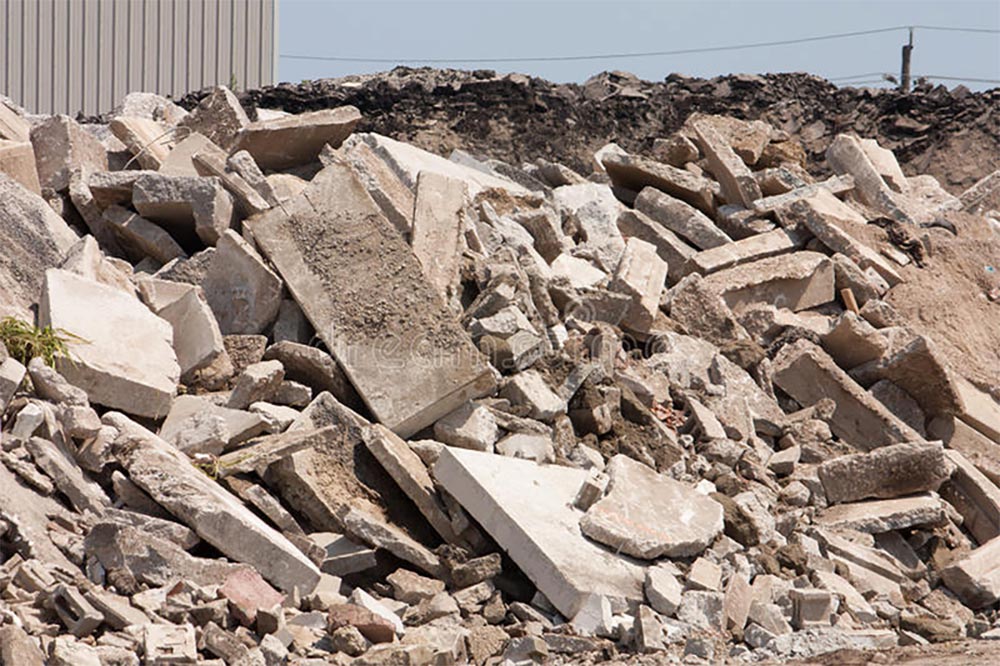 Impact of Recycled Concrete on Bangladesh
The use of recycled concrete in Bangladesh's construction industry has the potential to reduce construction costs significantly. The cost of materials is one of the most significant expenses in the construction industry. Moreover, using recycled concrete can reduce the need for transportation and disposal costs, further reducing the overall cost of construction projects.
Concrete waste recycling in Bangladesh has several positive economic and environmental effects. Utilizing recycled concrete in buildings decreases the need for new materials like limestone, gravel, and sand, protecting natural resources. Additionally, employing recycled concrete may open up new employment opportunities in the building and recycling industries, boosting the country's economy.
Challenges for Bangladesh in Recycling Concrete
There are several challenges that the recycling of the concrete waste in Bangladesh faces. One of the biggest challenges is the lack of awareness among stakeholders about the benefits of recycling concrete. Many construction companies in Bangladesh are still unaware of the potential of recycled concrete, and they continue to use virgin materials, which can contribute to the environmental consequence of the industry. The lack of proper infrastructure for recycling concrete waste is also a significant challenge, as there are not enough recycling facilities in the country.
To support the nation's aims for sustainable development, the government and the corporate sector must collaborate to promote and provide incentives for concrete recycling. The government's laws and rules for development might encourage the use of recycled concrete in building projects. The business sector can increase investments to create recycling facilities and cutting-edge technology and to improve concrete recycling's efficacy and efficiency.
Recycling concrete scraps can suggest a long-term remedy for Bangladesh's construction sector's waste management issues. The nation may develop a more circular economy that is sound for both people and the environment by implementing more environmentally friendly building techniques, cutting waste and carbon emissions, and protecting natural resources.
Aditya Chowdhury, Department of Civil Engineering, Chittagong University of Engineering and Technology (CUET)
Loading...
Loading...
Also read



Editor : Iqbal Sobhan Chowdhury
Published by the Editor on behalf of the Observer Ltd. from Globe Printers, 24/A, New Eskaton Road, Ramna, Dhaka.
Editorial, News and Commercial Offices : Aziz Bhaban (2nd floor), 93, Motijheel C/A, Dhaka-1000.
Phone: PABX- 41053001-06; Advertisement: 41053012; 01793317829, 01550707291, E-mail: [email protected], [email protected] Online: email: [email protected] 41053014; 01550707297 Advertisement: 01550707296
Published by the Editor on behalf of the Observer Ltd. from Globe Printers, 24/A, New Eskaton Road, Ramna, Dhaka.
Editorial, News and Commercial Offices : Aziz Bhaban (2nd floor), 93, Motijheel C/A, Dhaka-1000.
Phone: PABX- 41053001-06; Advertisement: 41053012; 01793317829, 01550707291, E-mail: [email protected], [email protected] Online: email: [email protected] 41053014; 01550707297 Advertisement: 01550707296


