



| HEADLINE |

|
Climate-induced displacement pushing up child marriage
Published : Monday, 15 March, 2021 at 12:14 PM
Shahenoor Akther Urmi


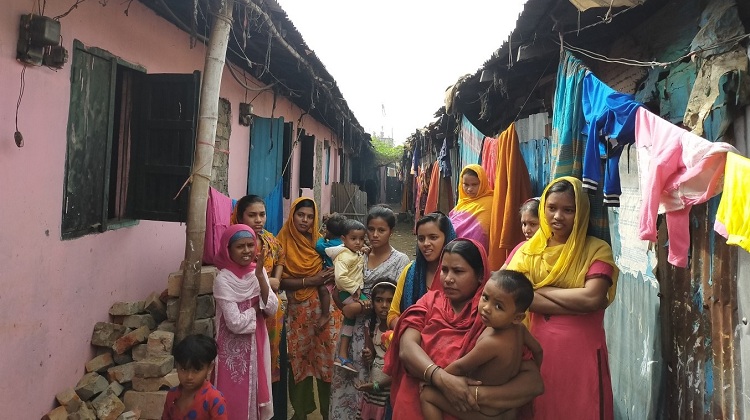
Holding a one-and-a-half-year-old baby in her lap, Bithi Begum,18, arrives at her mother’s house to drop off her son. Bithi first arrived in the city with her parents seven years ago in search of shelter after their home in Barishalcoastal district was washed away due to rising sea levels.
Bithi now lives in a slumat the station road area, while her mother lives with three more children in another slum named Bhera market near Chaktai area at Chattogram.
Bithi tied the knot with a street vegetable vendor three years ago when she was only 15. She couldn’t complete her primary education which is mandatory in Bangladesh since 1991 and has no proof of age or birth certificate.
“Our life in the slum is spinning in searching for shelter and bread. While marriage is the only way for parents to reduce the pressure of mouths in a family; age is not a consideration here,” Bithi said.
Like Bithi, thousands of young girls, displaced from their homes due to climate change, are facing the same fate — they have no choice but to get married at a young age.
“After losing everything, we moved to the city for shelter and to earn bread and butter to survive. We struggled to make ends meet and feed the family and were unable to send my daughter to school. We had no other option but to marry her off young,” said her mother Nasima Banu,35, who was also married off early.
Every year thousands of coastal people are moving to Bangladesh cities after losing their homes due to rising sea levels. According to a report titled ‘Climate Displacement in Bangladesh’ by the UK based Environmental Justice Foundation, by 2050, every seven people in Bangladesh will be displaced by climate change and because of sea-level rise up to 18 million people will be compelled to move to the main cities like Dhaka and Chittagong.
However, the struggle does not end when they move to new cities. Even their fundamental rights are not being ensured by the state. In the largest slum of the city called Chinnomul over 12,000 children are deprived of their birth certificates leaving them in vulnerable positions, with no access to social security, and susceptible to child marriage and crime. It also lands them into trouble in getting admission at school, getting national identity cards and proof of age in marriage registration.
Bithi is struggling to survive in the city so she is looking for a job.
This is the common scenario and fate most of the girls who are forced to migrate to the city with a climate refugee identity or born here.
How girls are vulnerable
According to the latest Unicefreport, Bangladesh has one of the highest rates of child marriages in the world, while it is also concern the rate of sexual violence has increased in the country which compels parents to marry off their children.
Multiple Indicator Cluster Survey 2019 by Bangladesh Bureau of Statistics state that a total of 19.8% of women in Bangladesh currently aged 15-49 were married before they turned 15.
The girls in at slums in the city are also victims of sexual abuse or forced marriage or forced sex.
“People in slums married off daughters at an early age for lack of security. They have to stay or live in places where security is elusive. So, girls are always targets of human traffickers for forced sex here when the slums are the main hub for the traffickers. Luring job they take away the girls and forced for sex and confined in rooms. We have saved at least 16 girls in Bakoilia slums who were supposed to be trafficked for forced sex,” said Muklershur Rahman Farhadi, Project coordinator in Chattogram of Bangladesh Society for the Enforcement of Human Rights, the NGO which is working for trafficking issues.
“We are dealing with many cases on it mainly the victims are from the slums—climate-induced displaced people—trafficked from the slums in names of job. Sometimes they lured them to take away abroad for a job. The traffickers are always taking the opportunity as these people are looking for job and shelter, ” added Farhadi.
According to the data of Manusher Jonno Foundation (MJF), collected from five national Bangla daily newspapers, titled ‘Bangladesh Child Situation 2020’ revealed beginning of the year that the number of child marriage has risen by 44% in 2020 as compared to 2019. Among them, some are victims of sexual abuse and are later forced to marry their abusers
Poverty and climate displacement are two of the main causes parents want to marry off their girls as wellbeing and social security are a serious concern for them. Female children are recognized as a ‘burden’ for the family, said Shaheen Anam, Executive Director of Manusher Jonno Foundation. Parents want to get rid of it after getting their girls married, she added.
‘The latest percentage is 62% in Bangladesh which is highest in South Asia,’ she informed.
The Bangladesh Government has several projects to prevent child marriage though the rate is increasing drastically. According to Child Marriage Action Plan 2018-2030, while the government tries to intervene and prevent child marriage, most parents under the poverty line see marrying off their girls at a young age as a more viable option.
Child marriage is increasing among the community of people who are living in the slum and remote areas migrated from other places, where proper surveillance should hard to maintain.
Due to Climate change the social approach of these marginalized people who migrated from Char or coastal areas have transformed their poverty into child marriage, proper and effective awareness can avert the rate of child marriage.
But due to limitations at a governmental level, lack of number of volunteers and related organizations, child marriage is rising. So, it becomes tough to prevent the issue only creating awareness and enforcement
‘More volunteer groups in the remote or slum areas can help to lessen the problem shortly,’ said M Muhibuzzaman, Joint Secretary of the Ministry of Women and Children Affairs.
Girls who get married off during their childhood also have to deal with the emotional and physical consequences of child marriage — domestic violence, early pregnancy, malnourishment, which might result in mother-child mortality and miscarriage. In some cases, all these costs affect their mental health and wellbeing.
Malnourishment in childhood and pregnancy period may lead to adverse consequences for mother-child survival. According to the National Institution of Population Research and Training data, around 5.5 million children under 5 years (36 per cent) are suffering from chronic malnutrition (stunting or low height-for-age) while 14 per cent are acutely malnourished (wasting or low weight-for-height).
Illiteracy leads towards Crimes
Bithi now lives in a slumat the station road area, while her mother lives with three more children in another slum named Bhera market near Chaktai area at Chattogram.
Bithi tied the knot with a street vegetable vendor three years ago when she was only 15. She couldn’t complete her primary education which is mandatory in Bangladesh since 1991 and has no proof of age or birth certificate.
“Our life in the slum is spinning in searching for shelter and bread. While marriage is the only way for parents to reduce the pressure of mouths in a family; age is not a consideration here,” Bithi said.
Like Bithi, thousands of young girls, displaced from their homes due to climate change, are facing the same fate — they have no choice but to get married at a young age.
“After losing everything, we moved to the city for shelter and to earn bread and butter to survive. We struggled to make ends meet and feed the family and were unable to send my daughter to school. We had no other option but to marry her off young,” said her mother Nasima Banu,35, who was also married off early.
Every year thousands of coastal people are moving to Bangladesh cities after losing their homes due to rising sea levels. According to a report titled ‘Climate Displacement in Bangladesh’ by the UK based Environmental Justice Foundation, by 2050, every seven people in Bangladesh will be displaced by climate change and because of sea-level rise up to 18 million people will be compelled to move to the main cities like Dhaka and Chittagong.
However, the struggle does not end when they move to new cities. Even their fundamental rights are not being ensured by the state. In the largest slum of the city called Chinnomul over 12,000 children are deprived of their birth certificates leaving them in vulnerable positions, with no access to social security, and susceptible to child marriage and crime. It also lands them into trouble in getting admission at school, getting national identity cards and proof of age in marriage registration.
Bithi is struggling to survive in the city so she is looking for a job.
This is the common scenario and fate most of the girls who are forced to migrate to the city with a climate refugee identity or born here.
How girls are vulnerable
According to the latest Unicefreport, Bangladesh has one of the highest rates of child marriages in the world, while it is also concern the rate of sexual violence has increased in the country which compels parents to marry off their children.
Multiple Indicator Cluster Survey 2019 by Bangladesh Bureau of Statistics state that a total of 19.8% of women in Bangladesh currently aged 15-49 were married before they turned 15.
The girls in at slums in the city are also victims of sexual abuse or forced marriage or forced sex.
“People in slums married off daughters at an early age for lack of security. They have to stay or live in places where security is elusive. So, girls are always targets of human traffickers for forced sex here when the slums are the main hub for the traffickers. Luring job they take away the girls and forced for sex and confined in rooms. We have saved at least 16 girls in Bakoilia slums who were supposed to be trafficked for forced sex,” said Muklershur Rahman Farhadi, Project coordinator in Chattogram of Bangladesh Society for the Enforcement of Human Rights, the NGO which is working for trafficking issues.
“We are dealing with many cases on it mainly the victims are from the slums—climate-induced displaced people—trafficked from the slums in names of job. Sometimes they lured them to take away abroad for a job. The traffickers are always taking the opportunity as these people are looking for job and shelter, ” added Farhadi.
According to the data of Manusher Jonno Foundation (MJF), collected from five national Bangla daily newspapers, titled ‘Bangladesh Child Situation 2020’ revealed beginning of the year that the number of child marriage has risen by 44% in 2020 as compared to 2019. Among them, some are victims of sexual abuse and are later forced to marry their abusers
Poverty and climate displacement are two of the main causes parents want to marry off their girls as wellbeing and social security are a serious concern for them. Female children are recognized as a ‘burden’ for the family, said Shaheen Anam, Executive Director of Manusher Jonno Foundation. Parents want to get rid of it after getting their girls married, she added.
‘The latest percentage is 62% in Bangladesh which is highest in South Asia,’ she informed.
The Bangladesh Government has several projects to prevent child marriage though the rate is increasing drastically. According to Child Marriage Action Plan 2018-2030, while the government tries to intervene and prevent child marriage, most parents under the poverty line see marrying off their girls at a young age as a more viable option.
Child marriage is increasing among the community of people who are living in the slum and remote areas migrated from other places, where proper surveillance should hard to maintain.
Due to Climate change the social approach of these marginalized people who migrated from Char or coastal areas have transformed their poverty into child marriage, proper and effective awareness can avert the rate of child marriage.
But due to limitations at a governmental level, lack of number of volunteers and related organizations, child marriage is rising. So, it becomes tough to prevent the issue only creating awareness and enforcement
‘More volunteer groups in the remote or slum areas can help to lessen the problem shortly,’ said M Muhibuzzaman, Joint Secretary of the Ministry of Women and Children Affairs.
Girls who get married off during their childhood also have to deal with the emotional and physical consequences of child marriage — domestic violence, early pregnancy, malnourishment, which might result in mother-child mortality and miscarriage. In some cases, all these costs affect their mental health and wellbeing.
Malnourishment in childhood and pregnancy period may lead to adverse consequences for mother-child survival. According to the National Institution of Population Research and Training data, around 5.5 million children under 5 years (36 per cent) are suffering from chronic malnutrition (stunting or low height-for-age) while 14 per cent are acutely malnourished (wasting or low weight-for-height).
Illiteracy leads towards Crimes
Because of a lack of proper documentation, most of the students could not continue their further study after the fifth standard among them some are facing problem in primary enrolment. Most of them are the utmost reason for child marriage and drop out student.
Because of some ‘Rohingya’ issue, District Administration has stopped providing birth certificates of climate refugees children in the slums which allegedly move them toward crime and illegal work.
As they are living in poverty working is their way to earn. The children are also involved in crime.
“Environment is the main factor. The children live in slums which are crime-prone area. So, the children, who migrated with their parents or born in the cities, the context of natural disaster or river erosion have involved in crime, said Saleh M Tanvir, Commissioner of Chattogram Metropolitan Police (CMP).
The drop out children either works in any roadside hotel or committed a crime like hijacking, snatching, drug paddling or contraband Yaba, he added.
Tanvir also said that the CMP have no record of numbers of especially migrated children who have involvement in crimes but he said the figure is rising gradually as the number of migrant children is increasing every year.
Child rights violated
The situation not only affected their child rights and protection also apprehended of their upbringing and future.
Bangladesh is working on achieving 17 Sustainable Development Goals where the first four of them are No Poverty, Zero Hunger, Good Health and Well-being and Quality Education. Those are also the requirements for Child Rights and due to Climate Change the right violated and children are at risk.
According to the Bangladesh Child Act 2013 well-being of the children encourage by family-based care and protection considering their participation, sanitation, proper education as well as security.
But the fact is those children who are the victims of climate change directly and indirectly and displaced are so far from the law and its implementation.
Simon Rahman, Manager-Urban Resilience of Save the Children said in order to overcome this lapse, Bangladesh should pay heed to the current landscape of national climate change policies, plans, strategies and the degree to which these are child-sensitive.
Ensuring social security and probable solution
Because of the Vast Ganges Delta, the migration process from coastal areas to inland or cities is complex in Bangladesh. Some are migrated for drought, flood while some are for river erosion and the increasing salinity in soil and water.
Prof Dr Farid Uddin Ahamed, Chairperson of Department of Development Studies of Chittagong University said Proper implementation of the Climate Fund, Bangladesh can minimize the problem.
Emphasising the Paris Agreement Farid suggest that global leaders should consider the agreement seriously for a sustainable world.
Farid who is the principal researcher of titled An Ethnographic Study on Financial Inclusion in Bangladesh said to achieve SDG Bangladesh should move forward with the vast community that are vulnerable to climate change.
With proper infrastructure building for the target group, rehabilitation of climate refugees; providing food and shelter to the most vulnerable group during disasters period will be considered as the solution to fight the post-climate change impact, he added.
Loading...
Loading...
Also read








Editor : Iqbal Sobhan Chowdhury
Published by the Editor on behalf of the Observer Ltd. from Globe Printers, 24/A, New Eskaton Road, Ramna, Dhaka.
Editorial, News and Commercial Offices : Aziz Bhaban (2nd floor), 93, Motijheel C/A, Dhaka-1000.
Phone: PABX- 41053001-06; Advertisement: 41053012; 01793317829, 01550707291, E-mail: [email protected], [email protected] Online: email: [email protected] 41053014; 01550707297 Advertisement: 01550707296
Published by the Editor on behalf of the Observer Ltd. from Globe Printers, 24/A, New Eskaton Road, Ramna, Dhaka.
Editorial, News and Commercial Offices : Aziz Bhaban (2nd floor), 93, Motijheel C/A, Dhaka-1000.
Phone: PABX- 41053001-06; Advertisement: 41053012; 01793317829, 01550707291, E-mail: [email protected], [email protected] Online: email: [email protected] 41053014; 01550707297 Advertisement: 01550707296


