What we think to happen naturally does not happen, but its opposite takes place. A good-natured man will live a happy and prosperous life, but an ill-natured man will face various sufferings. But in real life we see that a man who cultivates the good qualities like honesty, frugality, piety, sincerity is not happy. But a man who does the opposite lives a life of comfort and happiness. In the story 'The Ant and the Grasshopper', W. Somerset Maugham puts forward a moral that is based on the observation of life and by contrast shows that it does not correspond to life.
His experiences in the hospital where he treated the poor inspired his first novel 'Liza of Lambeth' (1897). Maugham wrote more than 200 stories which were published in various collections.
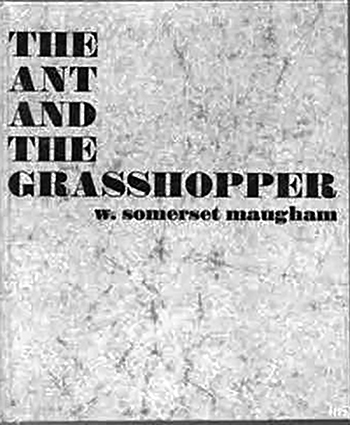
In this book titled, "65 Short Stories Complete & Unabridged", there are sixty-five stories written by W. Somerset Maugham. Among them, the story 'The Ant and the Grasshopper' is at number four. This story was the title of a special kind of story called the fable. The happening in the story is that George Ramsay and Tom Ramsay were brothers- George elder and Tom his younger by one year. Though they belong to a respectable family their characters differ. George is honest, hardy, sincere, frugal and virtuous. He is very dutiful to his job, and as well as to the members of his family. He thinks for the future, and saves a portion of his income for his old age.
Tom, on the other hand, is a rough. He starts business and marries. But suddenly he leaves both, his business and his wife with his children. He spends two years in the capitals of Europe in search of pleasure. After that he develops a habit of borrowing from his friends and acquaintances. He falsely promises that he would rectify his manner and takes money from George. But instead of starting his business again he squanders the money. He also blackmails his brother by a stratagem.
George with such an admirable character is supposed to be happier than Tom. He himself is confident that he would be able to spend his old age with the small amount of money he has saved. He is glad to think that his brother will live a miserable life in his old age, because he has all the bad qualities. George is hopeful that vice represented by his brother would not go unpunished. But the opposite happens.
Tom marries an old lady. She was very rich with a big amount of money and two houses- one in London and the other in a village. She dies suddenly. Now Tom becomes heir to the property of that woman. Now it becomes clear that he would be richer than George. He would lead a happier and more comfortable life than that of George. When George comes to learn it he is overwhelmed with surprise, anger and despair. He cannot think that a depraved man like Tom could deserve it. He bursts into saying, "It's not fair, I tell you, it's not fair. Damn it, it's not fair."
William Somerset Maugham was an outstanding English novelist and storyteller. Maugham was a keen observer of life and an ardent student of human nature. In his writings, his aim was to present life as it really is. He saw the contradictions and frustrations of life and tried to portray these in his stories. At the outbreak of the Second World War he was in France. After the war, he settled in France and died there in 1965 at the age of 91.
The fable of the ant and the grasshopper expresses the irony of life more clearly. As per the story of the fable, George resembled the ant and Tom resembled the grasshopper. This fable aims at explaining the moral that a person who labours hard is rewarded but a man who is easy-going and averse to labour is punished. So George was to be happy and richer and Tom was to be poor and he was to suffer. But the opposite happened. The contrast between the story of the fable and the happening in this story makes the reality more striking.
The reviewer is an ex academic, writer and MPhil research fellow in the School of Education, Bangladesh Open University