



| HEADLINE |

|
Record sargassum invasion hits Caribbean coasts, more expected in June
Published : Wednesday, 4 June, 2025 at 10:43 AM
Observer Online Desk


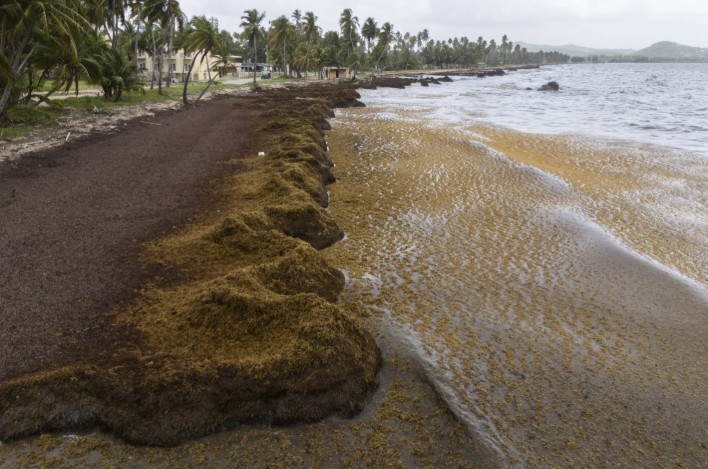
A record 38 million metric tons of sargassum seaweed blanketed the Caribbean and surrounding waters in May, disrupting daily life, wildlife habitats, and tourism from Puerto Rico to Guyana, according to a new report from the University of South Florida’s Optical Oceanography Lab.
This is the largest amount ever recorded since monitoring began in 2011, surpassing the previous record of 22 million metric tons set in June 2022. Scientists warn the situation is likely to worsen in June, as more of the prickly brown algae is expected to drift ashore.
Sargassum, while beneficial in the open ocean where it forms a habitat for marine life, becomes harmful near coastlines. Large quantities of it block sunlight needed by coral reefs, smother seagrass beds, and release gases like hydrogen sulfide and ammonia as it decomposes—posing health risks and forcing the temporary closure of schools in places like Martinique, AP reports.
Brian Barnes, assistant research professor at the University of South Florida, called the continued increase “alarming,” but admitted that the reasons behind the surge remain unclear. “It’s the million-dollar question,” he said, noting that scientists are studying how nutrients, water temperature, currents, and other environmental factors influence its spread.
Agricultural runoff and warming seas are suspected contributors. The algae reproduces rapidly and floats thanks to small air sacs, forming what scientists call the Great Atlantic Sargassum Belt.
The impact on Caribbean economies—many of which rely heavily on tourism—is growing. In places like Punta Cana in the Dominican Republic, authorities have installed sea barriers to keep the algae at bay. In St. Maarten, emergency cleanup efforts using backhoes were launched in late May after residents complained about overwhelming odors.
French Prime Minister François Bayrou acknowledged the severity of the problem, calling the seaweed an environmental and social nuisance: “It disfigures our coasts, prevents swimming and makes life impossible for local residents.”
Efforts to tackle the problem, however, face steep challenges. Specialized seaweed-collecting vessels are costly, and heavy machinery can endanger wildlife like nesting sea turtles. Most cleanup operations fall on hotels, some of which now offer refunds or shuttle services to cleaner beaches.
Sargassum levels typically rise in late spring, peak during summer, and taper off by late fall or early winter. But with 2025 already breaking records, concerns are mounting that the problem could become even more difficult to manage in the coming years.
This is the largest amount ever recorded since monitoring began in 2011, surpassing the previous record of 22 million metric tons set in June 2022. Scientists warn the situation is likely to worsen in June, as more of the prickly brown algae is expected to drift ashore.
Sargassum, while beneficial in the open ocean where it forms a habitat for marine life, becomes harmful near coastlines. Large quantities of it block sunlight needed by coral reefs, smother seagrass beds, and release gases like hydrogen sulfide and ammonia as it decomposes—posing health risks and forcing the temporary closure of schools in places like Martinique, AP reports.
Brian Barnes, assistant research professor at the University of South Florida, called the continued increase “alarming,” but admitted that the reasons behind the surge remain unclear. “It’s the million-dollar question,” he said, noting that scientists are studying how nutrients, water temperature, currents, and other environmental factors influence its spread.
Agricultural runoff and warming seas are suspected contributors. The algae reproduces rapidly and floats thanks to small air sacs, forming what scientists call the Great Atlantic Sargassum Belt.
The impact on Caribbean economies—many of which rely heavily on tourism—is growing. In places like Punta Cana in the Dominican Republic, authorities have installed sea barriers to keep the algae at bay. In St. Maarten, emergency cleanup efforts using backhoes were launched in late May after residents complained about overwhelming odors.
French Prime Minister François Bayrou acknowledged the severity of the problem, calling the seaweed an environmental and social nuisance: “It disfigures our coasts, prevents swimming and makes life impossible for local residents.”
Efforts to tackle the problem, however, face steep challenges. Specialized seaweed-collecting vessels are costly, and heavy machinery can endanger wildlife like nesting sea turtles. Most cleanup operations fall on hotels, some of which now offer refunds or shuttle services to cleaner beaches.
Sargassum levels typically rise in late spring, peak during summer, and taper off by late fall or early winter. But with 2025 already breaking records, concerns are mounting that the problem could become even more difficult to manage in the coming years.
SR
Loading...
Loading...
Also read



Editor : Iqbal Sobhan Chowdhury
Published by the Editor on behalf of the Observer Ltd. from Globe Printers, 24/A, New Eskaton Road, Ramna, Dhaka.
Editorial, News and Commercial Offices : Aziz Bhaban (2nd floor), 93, Motijheel C/A, Dhaka-1000.
Phone: PABX- 41053001-06; Advertisement: 41053012; 01793317829, 01550707291, E-mail: [email protected], [email protected] Online: email: [email protected] 41053014; 01550707297 Advertisement: 01550707296
Published by the Editor on behalf of the Observer Ltd. from Globe Printers, 24/A, New Eskaton Road, Ramna, Dhaka.
Editorial, News and Commercial Offices : Aziz Bhaban (2nd floor), 93, Motijheel C/A, Dhaka-1000.
Phone: PABX- 41053001-06; Advertisement: 41053012; 01793317829, 01550707291, E-mail: [email protected], [email protected] Online: email: [email protected] 41053014; 01550707297 Advertisement: 01550707296


